DON'T BELIEVE THE
HYPE:
Light Brown Apple Moths are NO THREAT!
But PESTICIDES ARE!!!
Organic Farmers,
Healthcare Workers, Organized Labor, Direct Action and
other Activists, the Chemically-Injured, and other Concerned People
contact us
|
3/22/10: FINAL
PROGRAMMATIC ENVIRONMENTAL IMPACT REPORT FOR THE LBAM PROGRAM CERTIFIED!
See details of what CDFA may be planning in your area Support the Statewide Lawsuit
against LBAM Program Farmers, Growers, Nurseries Oppose the Program USDA-APHIS Response to Reclassification Petitions PUBLIC COMMENTS DUE MAY 14, 2010 *
Who's
Afraid of the Light Brown Apple Moth? - 92 min |
Topic Overview About the Pesticides How to Prepare What's the Emergency Groups Organzing Against the Program
Resolutions and Official Letters
|
According to the U.S. and California Departments of Agriculture (USDA, CDFA), the light brown apple moth (LBAM) is a threat to agriculture, our ecosystem, and the economy, even though it has caused no actual damage. Independent scientists have indicated that the LBAM has likely been here for decades, not just a couple of years as claimed by the Ag Department, during which it has become part of our local ecosystem, and is kept in check by natural predators, just as the many native species of similar leafrolling moths.
The USDA and CDFA nevertheless went into battle against the LBAM, setting traps throughout California, and in 2007 hosed down neighborhoods in Oakley and Napa with pesticides, followed by toxic twist ties in several more neighborhoods, and aerial spraying over Monterey and Santa Cruz. Even though hundreds of people reported getting ill from the spraying, and hundreds of birds died immediately afterwards, the CDFA declared that the illnesses and deaths were coincidental, and that the trapping, twist ties and aerial spraying, and other pesticide methods would continue and be expanded to the larger Bay Area and any other area where an LBAM is found.
Earlier in 2008 the areas to be targeted for pesticide applications of all sorts against the LBAM totalled 571,259 acres, 892 square miles. That area has since been expanded to most of the state:
 |
|
| Red dots represent approximate areas in which the CDFA claims LBAM trapped from Sonoma to Santa Barbara. See CDFA's own quarantine maps for updates and specifics. | On July 21, 2008, the CDFA announced the intention to expand the LBAM program to most of California, which is represented by the grey area. |
THERE IS NO SAFE USE OF PESTICIDES
ABOUT THE LBAM PESTICIDE PROGRAM:
For information about what applications are planned in your area, please check the LBAM page of the California Department of Food and Agriculture for the latest. Keep in mind that CDFA has not been reliable in their notification of the public.
What
Would Larry, Moe and Curly Do?
"SPLAT, confetti, goop, wasps-the state's new weapons against the apple
moth sound like a joke, but they're not." News story from 2008, before
the program's plans were finalized.
"INERT" INGREDIENTS
All of these pesticides contain "inert" ingredients, which are kept undisclosed, protected as "proprietary" by trade secret laws, are frequently even more toxic than the "active" ingredients listed on the label, and are specifically designed to interact synergistically to achieve greater toxicity than each chemical by itself.
The Impacts of Chemical Mixtures - Our Stolen Future
Synergism by Ingrid Pollyak
While
government agencies and pesticide manufacturers downplay the importance
of synergism, this essay, by a teen who homeschools, illustrates that
understanding synergistic effects of chemicals does not require a
Ph.D.
Even though all of the pesticides contain synthetic ingredients, several of them are "approved" by the U.S. Department of Agriculture, National Organics Program, and the Organic Materials Review Institute for use in organic agriculture, further diluting organic standards.
IT'S NOT JUST A "PHEROMONE"
USDA's
Environmental Assessment of the LBAM Program, July 18, 2007
"Pheromones may be used in mating disruption. The idea behind this is
to saturate the area with so much pheromone that it is impossible for
the male moth to find a female. ... Applications of pheromone can occur
in a variety of ways."
The "LBAM pheromone" is a new, synthetic chemical, and
classified as a pesticide. As
of January 1, 2010, the Department of Pesticide Regulation lists LBAM
pheromone products on the list of pesticide products prohibited
from use in schools and child care facilities (Note that these
rules change periodically, and should not be taken for granted - this
prohibition is current as of late February 2010).
CDPR List of Pesticide Products Prohibited from Use in Schools and Child Care Facilities
USDA
quarantine exemption request (pdf)
Request to use a new chemical -- (E,E)-9,11-Tetradecadien 1-yl Acetate
--which at that time was not tested, nor was it registered by the EPA.
A declared
emergency
precludes the usual environmental impact reporting and public comment.
This is the "pheromone", the "active" ingredient in LBAM traps, twist
ties, SPLAT, and aerial spray.
The limited acute testing of some LBAM products, which was ordered by Governor Schwarzenegger in 2008, revealed serious safety concerns, including discolored organs in exposed test animals, and effects on the immune system. The LBAM products tested were SPLAT and Disrupt, two of the products listed in the Final Programmatic Environmental Impact Report, CheckMate, which was sprayed over Monterey and Santa Cruz and was later pulled by the EPA, and NoMate, which is no longer being considered for this program. The most commonly used application methods, the twist ties and traps, were not included in the testing.
OEHHA 6-Pack Acute Testing Review
Dr.
Ann Haiden's Commentary
about 6-Pack Tests
"There were worrisome findings that require explanation and
investigation, such as abnormal organs, one death and consistent
evidence of skin sensitization related lymph node activation in the
test animals. ... The consensus has downplayed the positive
lymph
node tests (LLNA), which evaluate early phase lymph system activation
by measuring lymphocyte proliferation. The positivity of this test,
rather than being questionable or of marginal importance, is more
likely a landmark finding for how environmental chemicals effect and
set the immune system on its future course. These findings may give
profound insights into how and why there is a persistent increase in
immune, neurological and inflammatory related illness in the
population."
Statement
regarding 6-Pack Tests by Stop the Spray, followed by detailed comments
by John Thielking
On
the Apparent Persistence of Disparlure In the Human Body E.
Alan Cameron
17 years after working with a similar chemical, disparlure, the
synthetic "pheromone" aimed at the gypsy moth, a man continued to
attract moths.
Even though traps are not considered part of the eradication program, but part of a monitoring program, the lures inside them contain the "pheromone" pesticide. Traps determine which areas are quarantined and targeted for more pesticide applications, which in the 1980's during the medfly program in Los Angeles resulted in people disappearing traps. The same can currently be witnessed with mosquito traps in Virginia, in a county already being sprayed aerially for the gypsy moth, and where the health department promises that "mosquito surveillance data" may result in the spraying of "adulticides".
Some opponents of the CDFA's LBAM project are proposing "pheromone" traps as an alternative to the aerial spray program. The traps, however, which are currently used to find LBAM, also contain the same synthetic "pheromone" as the twist ties, SPLAT, and aerial spray, as well as secret ingredients, and put at risk other beneficial insects, especially honeybees, who are attracted to various colored traps, and who are in a real global emergency due to "Colony Collapse Disorder", in which pesticides have been implicated. It is clear that neither the "pheromone" nor these traps are "targeted", as moths have to be tested to see if it's really an LBAM and not a local look-alike.
Scenturion Lures LBAM
- Manufacturer's MSDS (pdf)
These Traps are made by Suterra, the same manufacturer as of CheckMate,
the aerial spray used over Monterey and Santa Cruz in the Fall of 2007.
Notice that there are no ingredients listed on this MSDS at all. When asked about the ingredients, even just the "active" ingredients, Suterra's representative refused to provide them, and referred us back to the CDFA, confirming that their traps are in fact the ones being used in this program at this time.
Email exchange between Maxina Ventura and Suterra
Bids for a new LBAM Lure are being solicited by USDA-APHIS, with the following chemical requirements:
"Each Light Brown Apple Moth lure will consist of a synthetic rubber (halobutyl) septum loaded with 3mg of a 20:1 to 24:1 mixture of E11-tetradecen-1-ol acetate (= trans-11-tetradecenyl acetate) to E9, E11-tetradecadienyl acetate. These compounds should be applied to the septum in a solution of a solvent such as hexane (e.g., 3mg in a 100 ul of solvent) which is allowed to evaporate from the septum. … The materials should be applied in a solvent rather then "neat" as this may affect their absorption into, and subsequent release from the halobutyl rubber."
This requirement was later amended to also allow a "PVC matrix type dispenser in lieu of a synthetic rubber septum".
Hexane is a neurotoxin and causes central nervous system depression. It is a narcotic agent, and an eye, respiratory, and skin irritant. "Symptoms observed include dizziness, giddiness, slight nausea, and headache. Chronic inhalation exposure to hexane is associated with polyneuropathy in humans, with numbness in the extremities, muscular weakness, blurred vision, headache, and fatigue."
Pheromone Trap Colour Determines Catch of Non-target Insects - New Zealand Plant Protection Society
Pheromone Search - 942
Monterey County Moths - Lancelot Houston (526 KB pdf)
"Non-target" moth species in Monterey County, affected by the CDFA's
supposedly "targeted pheromone"

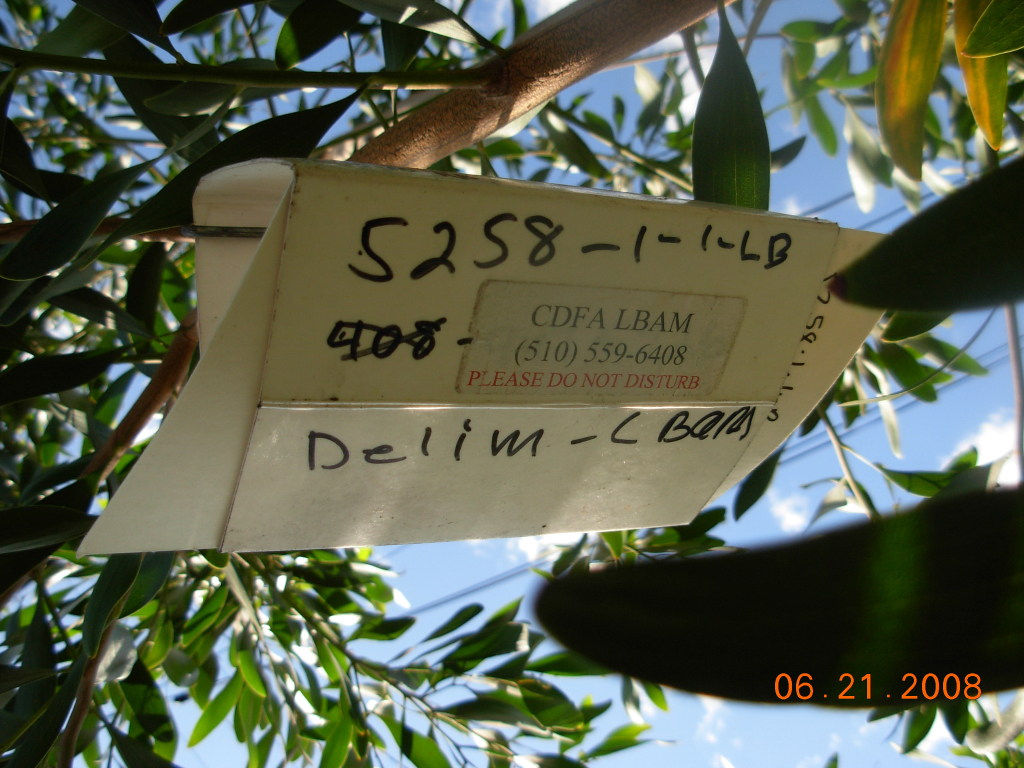
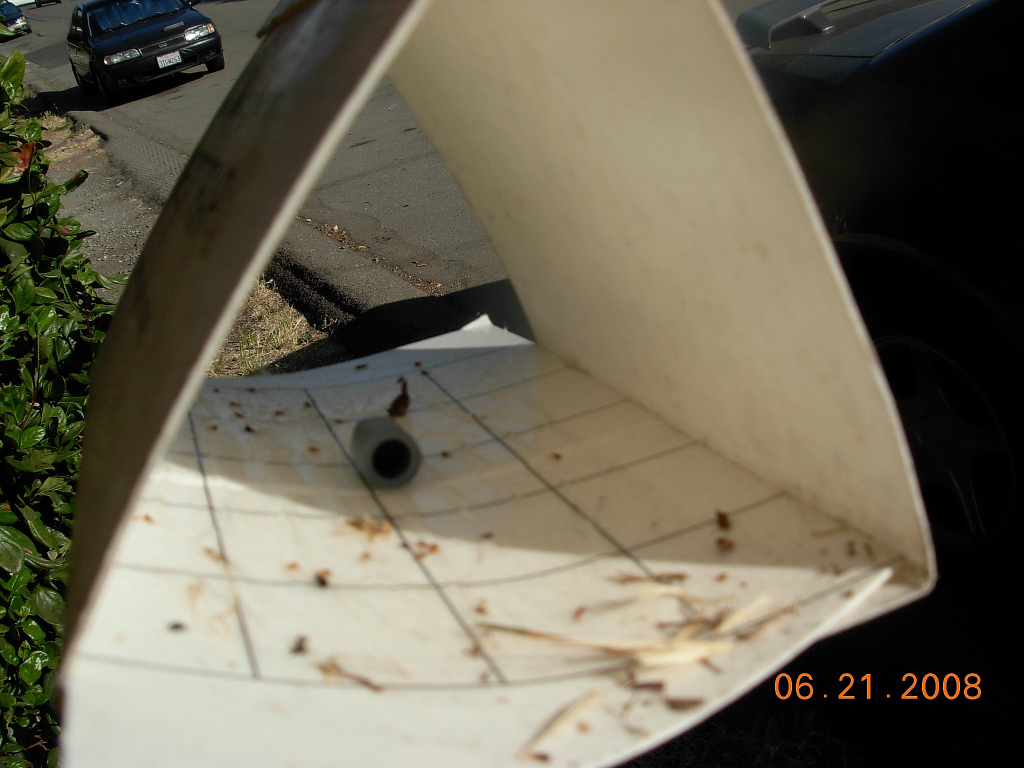
An LBAM trap in Cherryland, adjacent to the City of Hayward, with a non-target insect stuck inside:
 |
 |
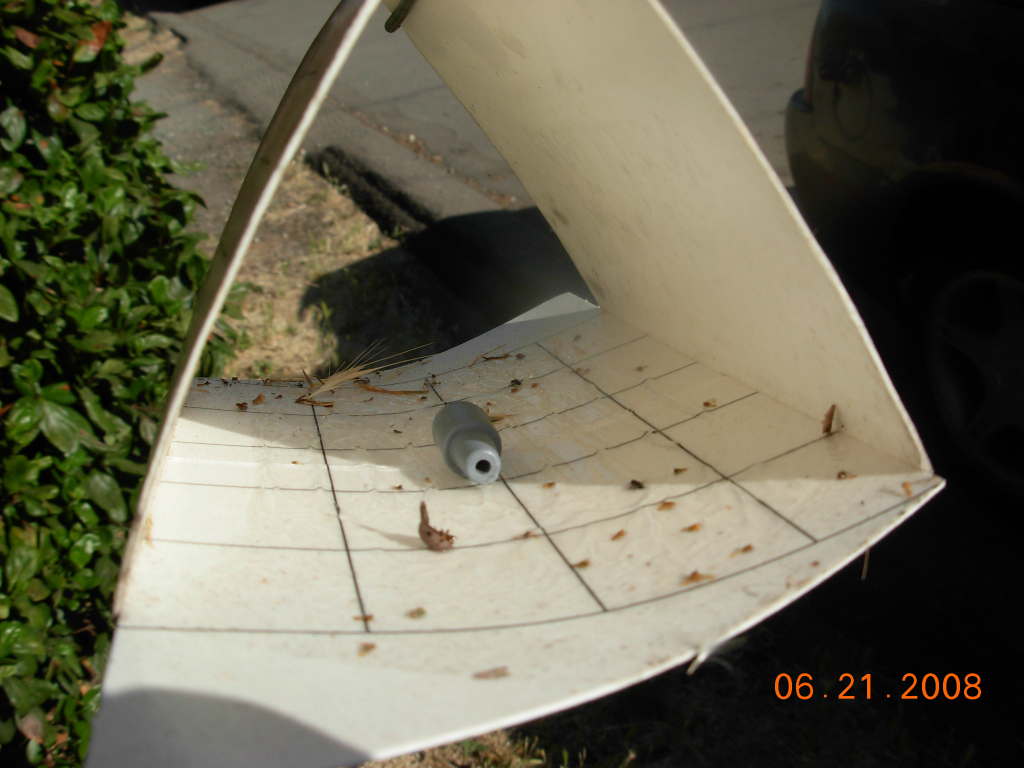 |
| Found & photographed by Dan Egolf |
Artist depiction of possible exposure to children:
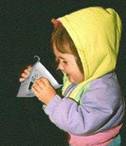
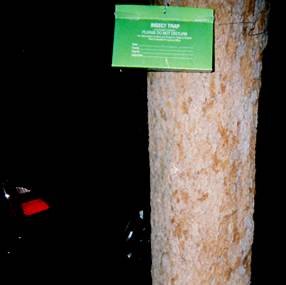
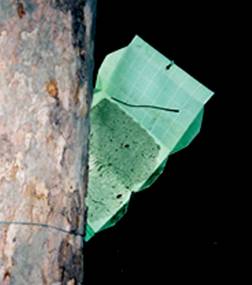
Example of likely route of exposure in real life: A government insect trap, torn open, likely by children who frequent the area in Oakland where this photo was taken. The photo on the left is of an intact insect trap of the same kind as the torn one on the right. These traps are for the Asian Gypsy Moth.
The black line in the top third of the broken trap is a rope, similar to the twist ties, which contains the synthetic "pheromone" disparlure, which has been found to persist in people's bodies for years.
"PHEROMONE" TWIST TIES
Isomate LBAM Plus Twist Ties - MSDS (pdf)
And the label warns "Hazards to Humans and Domestic Animals":
Isomate LBAM Plus Twist Ties - Label (pdf)
Federal Contract Award for LBAM Twist Ties September 2009
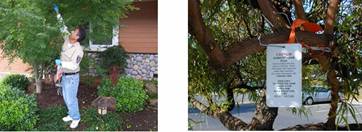
Many are placed
quite low, in easy reach of climbing and curious children and animals,
as can be seen in these pictures from a CDFA report.

And these artist depictions of possible contamination of pets and wildlife:
 |
 |
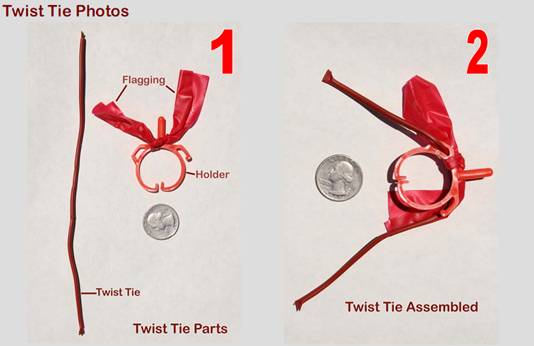
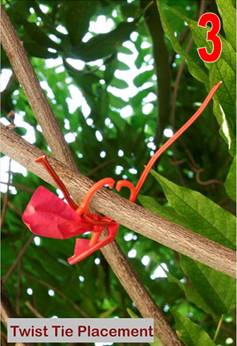
New twist tie clip, first publicly revealed at Sonoma Board of Supervisors meeting with CDFA on July 8, 2008:
"PHEROMONE" SPLAT
SPLAT (Specialized Pheromone & Lure Application Technology), a mix of the synthetic "pheromone" and other secret ingredients, was initially planned as a "pre-treatment" for, or concurrently with, aerial spraying, to be applied in a "clay matrix", every 30-60 days, 8 feet off the ground, just overhead of passers by and in easy reach of climbing children and animals, to a minimum of 3000 utility poles and trees per square mile. After the aerial spraying of "urban" areas was removed from the program, and as of February 2010, the Final Programmatic Environmental Impact Report for the LBAM Program now lists this method as one to be used instead of aerial spraying in those areas.
The CDFA has described this method as a process of "painting", though upon questioning, no one at the CDFA hotline had any information about the details. The USDA treatment plan for the LBAM describes it as mixed into either a "paraffin wax material" or Min-U-Gel, also known as Fullers earth or Attapulgite clay, and applied "as a very coarse squirt from a metered hand-held wand." According to the Santa Cruz Sentinel, after interviewing Steve Lyle, CDFA Director of Public Affairs, "The goo would be squirted by a person in a van onto power poles and trees 8 feet high - on public and private property."
The USDA admits that the crystalline "silica quartz component of the clay is listed as a possible human carcinogen under California Proposition 65 for inhalation exposure; however, since the material is mixed with liquid diluent, it will not be available for inhalation." But potters know that clay dries fast in the air, and crumbles in little time.
The document claims that the "direct application of this material to trees and poles eliminates the possibility of drift". It also describes the pheromone as "highly volatile". The description that the chemicals are formulated in such a way as to provide for a "slow release to the atmosphere", says it all. If the moth can perceive it, then we are exposed to it too.
According to the Mercury News' interview with Lyle, the pesticide "should dry within a week" after application. The USDA claims that "the ability of both formulations to become rainfast once the material is applied reduces any potential for run-off." Simultaneously they want us to think of the clay as the same as what's in that horrid pink stuff for diarrhea. Imagine all that Pepto-Bismol stuck to people's insides, that a good guzzling of water couldn't flush down. Imagine what might happen to wax on a hot, inner city California day, stuck to a pole. Imagine what the full "potential" of their toxic run-off might be, if it wasn't "reduced"...
SPLAT (Specialized Pheromone & Lure Application Technology)
 |
 |
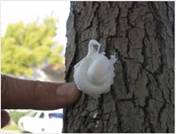
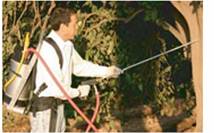
This is what it
might look like, though the CDFA has not released any pictures of the
surface area, color, or density of this pesticide application.
 |
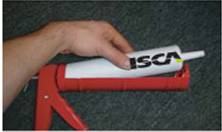 |
Perhaps one of these is the method of application. Both "metered" wand (left) and caulk gun (right) have been mentioned as possibilities for their drive-by squirting. And Max Suckling, a member of the Technical Working Group, and his agency HortResearch, which is partnering with the CDFA and USDA in LBAM-related research in New Zealand, are described as attempting to develop a method involving a "paintball gun" to shoot the "pheromone" onto tree trunks, which is the method pictured below:
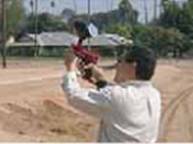
Videos of some application methods on the Manufacturer's YouTube page
This is how a different formulation of a SPLAT-like product is applied in another CDFA pesticide program:
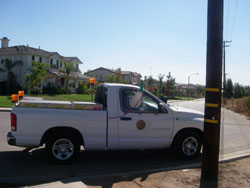
And here that same pesticide program, caught in action and upclose in Los Angeles by urban homesteaders (see their blog for all pictures in large size):
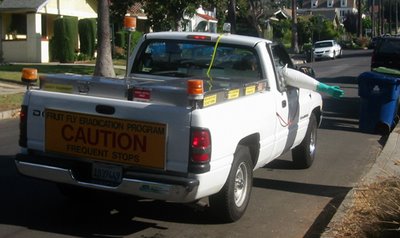
This method was initially proposed with permethrin added to it, but was finally removed from the program because of permethrin's cancer risk.
We continue to include the following information here as a record of the toxic chemicals that CDFA and USDA have been all too willing to expose the public to:
Permethrin is a neurotoxic, carcinogenic, endocrine disrupting, chromosome damaging insecticide, that is especially deadly to cats.
Dangers of Permethrin Fact Sheet by Caroline Cox
Most recent toxicological profile for Permethrin (or download pdf here)
Ground
Spraying Coming in March 2008 - CASS Fact Sheet (MS Word)
More toxicology of Permethrin and Btk compiled by California Alliance
to Stop the Spray
AERIAL "PHEROMONE" APPLICATIONS
PLEASE NOTE THAT AS OF MARCH 22, 2010, CDFA HAS ELIMINATED AERIAL APPLICATIONS OF "PHEROMONES" FROM THE LBAM PROGRAM
According to the Certification of the Final Programmatic Environmental Impact Report, which accompanied the Notice of Determination, CDFA has eliminated aerial applications of "pheromones" from the LBAM Program, but as always, CDFA uses contradictory language, and also states that: "CDFA finds that Alternative MD-3 is infeasible at this time. Alternative MD-3 will not be implemented as part of the proposed Program; CDFA will not be making any aerial releases of insect pheromone as a management strategy for the LBAM Program." (Emphasis ours)
While, it appears that the aerial applications described in the following section have been eliminated from the program, we continue to include the information as record of what CDFA and USDA had previously planned for us:"PHEROMONE" SPLAT
Please note that SPLAT, as described above, is also listed in the Programmatic Environmental Impact Report for this program as potentially applied by plane.
DISRUPT
The new product the EPA approved in January 2009 for the aerial portion of the LBAM program after CheckMate was pulled is Hercon's Disrupt Bioflake LBAM.
Disrupt Bio-Flake LBAM Product Label
While other versions of Disrupt have been made with PVC, and the original version of Disrupt for LBAM as it was originally posted on the manufacturer's website was also said to be made with PVC, in the Final PEIR they now insist that there is "no plastic" in the flakes, but that they are made of "starch-based polymer". What precisely constitutes "starch" this chemical cocktail is mixed is not being disclosed:
"The Draft PEIR stated by mistake that Hercon Bio-Flake is made of a layer of pheromone sandwiched between layers of plastic. In actuality, for the Hercon Bio-Flake proposed for use in the Program, the outer layers are composed of a biodegradable polymeric controlled release flake with the pheromone contained between two outer layers of starch-based polymer".
"A 'Sticker Agent' will be mixed with Disrupt Bioflake LBAM for adherence of the flakes to foliage":
According to the Application for approval to Import a Hazardous Substance to New Zealand, when this product was tested, the adhesive to be used with Hercon flakes was the following, called Micro-Tac II, manufactured by Lock N' Pop.X3221 Micro-Tac II
Sticker Agent
Manufactured by Lock
N Pop (Key Tech Corporation)
Lock N Pop do not make their specialty adhesives publicly available on their website, and the manufacturer's Material Safety Data Sheet, sent to us upon request, lists no ingredients at all:
According to the Final PEIR the adhesive to be used in this program now is still called Micro-Tac II, but is manufactured by Aberdeen Road Company. It is unclear whether the previously mentioned adhesive is the same as the one mentioned now. Hercon, the manufacturer of Disrupt, is apparently a registered trademark of Aberdeen Road Company, ie. they are the same company, also doing business under the name Herculite.We continue to include the following information about the previous version the manufacturer had posted on their website as record of the toxic chemicals CDFA and USDA have been all too willing to expose the public to:
Disrupt
Micro-Flake LBAM Manufacturer's "fact sheet" (pdf)
"This is an unregistered product approved under Section 18 of FIFRA.
For Use in State of California Only" - "Disrupt Micro-Flake LBAM is
manufactured using four main components; the pheromone (active
ingredient), an inert polymer film, an inert polymer resin, and an
inert
biodegradable plasticizer. The product is manufactured in the form of a
three-layered laminate of 'sandwich' consisting of two outside barrier
films, and a middle reservoir layer consisting of the phermone, resin,
and plasticizer. This laminate structure protect the contained phermone
from environmental degradation and rapid evaporation, permitting its
useful controlled release over extended periods. When the laminate is
cut into flakes, the pheromone slowly migrates through to the outside
edges of the barrier films and is released from the surface of the
flake over 80-90 days."
Disrupt
Micro-Flake Manufacturer's MSDS (pdf)
Note that none of the 89% "inert" ingredients are listed. And while
they don't expect "significant toxicity", they warn to use "appropriate
procedures to prevent direct contact with skin or eyes and prevent
inhalation."
Disrupt
Micro-Flake Manufacturer's (Draft) Label (pdf)
The chemical mixture is embedded in polyvinyl chloride (PVC, vinyl)
flakes, which is also not non-toxic,
not in its manufacture,
nor disposal, and not when ignited. In a list
of accidental fires involving PVC, Greenpeace finds that it
contributed to the start and/or spread of each fire, and "emitted
life-threatening gases and chemicals":
"Besides the acidic hydrogen chloride, a wide variety of chlorinated
and non-chlorinated organic chemicals evolve from PVC during high
temperature pyrolysis and combustion: benzene, toluene, formaldehyde,
chloroform, chlorinated biphenyls, dioxins and dibenzofurans, and many
others. The emission during fires of benzene, chlorinated dioxins, and
dibenzofurans - known carcinogens - appears to explain the high
frenquencies of leukemia, laryngeal and colon cancer, and of the rare
soft tissue cancers found in many firefighters at relatively young
ages."
PVC flakes spread everywhere promise to cause toxic fumes during
possible fires, be they wildfires, house fires, or campfires in the
near future. Even the manufacturer's MSDS admits that when
Disrupt flakes are burned "the hazardous decomposition products that
will result because of incomplete combustion include carbon monoxide,
other unidentified products of hydrocarbon degradation, Nox,
low level
cyanides and hydrogen chloride".
Hercon claims that the plasticizer used in Disrupt is biodegradable,
but no other details are disclosed. The most common PVC plasticizers
are phthalates, which can be classified as biodegradable, but which
have been linked to endocrine
disruption and are possible carcinogens.
CHECKMATE
This formulation has been removed from the program, though not until after hundreds were injured by it as a result of aerial applications in 2007:
CheckMate, a mix of synthetic "pheromones" with undisclosed "inert" ingredients, was planned to rain down on California's San Francisco Bay Area and the Monterey and Santa Cruz Peninsula, applied by airplanes. These chemicals have never been tested for safety. After much pressure from residents whose neighborhoods were already sprayed, and who were sickened, the "inert" ingredients of only one of the two chemical formulations used in 2007, CheckMate LBAM-F was disclosed. It remains unclear if the list of ingredients is complete, as State officials ordered the list of ingredients released "to the maximum extent possible under U.S. trademark law". While a few ingredients of the other formulation, CheckMate OLR-F, were leaked to the public, the full list of ingredients remains a secret.
The
EPA since rescinded
their approval of CheckMate, though has approved another new
"pheromone" product (Hercon's Disrupt Bioflake LBAM, see below) for
future aerial applications, which is still planned for communities in
so-called "non-urban" areas.
Overview of all known ingredients of CheckMate
Most recent indepth toxicological profile for CheckMate (or download 40 page pdf here)
Declaration of Richard Philp, toxicology professor, on CheckMate (quick and easy to print out overview)
Analysis of CheckMate by Dr. Lawrence Rose, M.D., M.P.H., recently retired senior Public Medical Officer for Cal-OSHA, and Occupational/Environmental Medicine practitioner at UCSF:
"These short term complaint symptoms are consistent with known toxicology scientific information of the ingredients of Checkmate... These ingredients include irritants, sensitizers, nervous system disrupters, endocrine disruption, allergens, and hypersensitivity induction. Long term health effects are also of concern due to the known induced mutations and suspected cancer risks of constituent chemicals."
 |
 |
More about Polymethylene polyphenyl isocyanate, the secret ingredient in CheckMate OLR-F
Analysis of the Encapsulation Process and Encapsulated Products, such as CheckMate capsules
LBAM Spray, PM10, and 630,000 Deaths The impact of particle pollution
Study
of effectiveness of pollen traps in reducing poisoning of bee hives by
microencapsulated pesticides
Microcapsules used in pesticide manufacturing are the size of pollen
grains, and are collected with pollen by foraging bees, and carried
back to the hive. The pesticides within the microcapsules were later
found in dead bees, and even though they were also found in pollen
traps, their presence "did not significantly reduce bee deaths or
pesticide residues".
FRUIT FLIES AS CARRIERS OF THE "PHEROMONE"
Another disturbing aspect of this program is the possibility that fruit flies could be doused with the "pheromone", then released by air, by the millions, as "Mobile Mating Disruption (MMD)", as another application method of the pesticide. While this method is not listed in the Programmatic Environmental Impact Report for this program, such methods have been proposed by Max Suckling, who is the "pheromone" expert on the LBAM Technical Working Group, and dubs this method a cross species "Menage-a-trois". Releases of thousands of such "perfumed fruit flies" already occurred in Australia. At the Sacramento EIR Scoping Meeting (YouTube) in August 2008, CDFA's Dr. Bob Dowell explained: "We are looking at other ways of developing and delivering the pheromone, including the use of third party insects, so to speak." Research in this area is indeed underway by the USDA:
USDA
Agricultural Research Service LBAM Research Project
"Research Project: Mobile Mating Disruption, the Sterile Insect
Technique and Attract and Kill for Areawide Control of Light Brown
Apple Moth"
Start Date: Dec 01, 2007
End Date: Nov 30, 2011
OTHER PESTICIDES AND ERADICATION METHODS
CHLORPYRIFOS
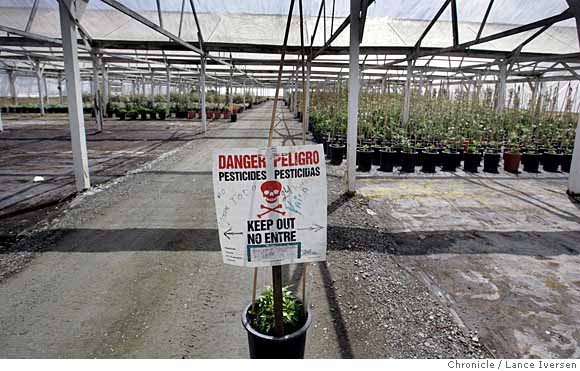
Nurseries are being forced to spray any plants suspected "infested" with chlorpyrifos, destroy plants, or close down. Chlorpyrifos is a broad spectrum organophosphate insecticide that damages the immune and central nervous systems, is associated with birth defects, and genetic damage. It contains other hazardous "inerts". One commonly found is xylene, which can cause hearing and memory loss, and leukemia. Chlorpyrifos is also toxic to beneficial insects, such as bees, ladybugs, and parasitic wasps, as well as fish, a wide variety of other aquatic organisms, and birds. Cats and other mammals have been poisoned, and even plants have been damaged by it. Chlorpyrifos is manufactured by Dow AgroSciences.
Toxicological Profile of Chlorpyrifos (pdf) by Northwest Coalition for Alternatives to Pesticides (NCAP)
Chlorpyrifos Fact Sheet (pdf) by Chemical Watch and Beyond Pesticides
Farmworkers
sue over Chlorpyrifos danger San Jose, July 2007
"Farm workers and advocate groups today filed a lawsuit in federal
district court today against the Environmental Protection Agency to
stop the continued use of a deadly pesticide called chlorpyrifos.
Chlorpyrifos is a highly neurotoxic insecticide developed from World
War II-era nerve gas. Exposure can cause dizziness, vomiting,
convulsions, numbness in the limbs, loss of intellectual functioning,
and death."

BTK
Bacillus
thuringiensis kurstaki, a bacteria mixed with secret "inert" chemical
ingredients, has been, and may continue to be, sprayed by hand on
vegetation, including on private property. During the 2007 LBAM program
Btk was sprayed repeatedly on 146 properties in Oakley and 90 in
Napa. It is implicated in gastro-intestinal illness and damage to the
immune
system. It has
sickened thousands of people
in New Zealand, prompting resistance which led to a People's Inquiry
when their government was unresponsive. The
formulation used in this program is manufactured by
Valent.
Toxicological
Profile for Bt by Northwest Coalition for
Alternatives to Pesticides
(NCAP) (pdf)
Toxicological
Profile for Btk
by Northwest Coalition for Alternatives to Pesticides
(NCAP)
(pdf)
No
Spray Zone Overview of Btk (pdf)
(Unfortunately until
recently No
Spray Zone supported the use of disparlure
as a "natural" alternative to Btk, and their webpage on the subject
remains somewhat contradictory, and the NCAP tox profile for Btk
takes a somewhat neutral position on synthetic "pheromones".)
The Btk product used by the CDFA in the LBAM program, is being sprayed
from high pressure hoses. It is called DiPel
Pro DF, and contains Bacillus thuringiensis var. kurstaki (Btk), in a
46% mix of undisclosed, proprietary chemicals. Pesticide information
from the manufacturer, which is obviously not as
reliable information as independent
science, downplays the risk of harm of
their product. But even their Material Safety Data Sheet, label, and
Organic Certificate from the Organic Materials Review Institute, don't
deny that there are serious risks:
According
to the manufacturer's MSDS: "MEDICAL CONDITION AGGRAVATED BY
EXPOSURE: Impaired respiratory function."
DiPel
Pro DF Material Safety Data Sheet (MSDS)
In 2005,
the U.S.
Surgeon General reported that in the U.S. 1 in every 8
children has asthma, and the number of asthma sufferers had tripled to
20 million over the 25 years prior, that every day 12 people die and
5,000 emergency room visits are due to asthma.
Asthma is
just one of many conditions that impair respiratory function.
According
to the label's First Aid instructions, on inhalation of the
product, "if person is not breathing",
call an ambulance and "give artificial
respiration", and skin contact requires rinsing
"immediately with plenty of water for 15-20 minutes".
DiPel
Pro DF Label
The
label clearly states:
"Do not apply
this
product in a way that will contact workers or other
persons, either directly or through drift."
Pictures of
CDFA hosing down a neighborhood with Btk during the LBAM program in 2007
In these pictures the pesticide is not dispensed from common backpack
sprayers, but from trucks with long hoses dragged through the
neighborhood
SPINOSAD
Spinosad is another product to be used in this manner. It is "approved" for organics, representing further dilution of organics standards. It is considered non-synthetic, but also contains undisclosed synthetic "inerts". Spinosad is implicated in the killing of non-target species. In a world with modern agriculture facing vanishing pollinators, we must not take lightly the possibility of further impacting crippled species. Spinosad is very toxic to honeybees, oysters and other marine mollusks, and somewhat toxic to birds, fish, and aquatic invertebrates. Ironically it is also harmful to the Trichogramma wasp, another part of the LBAM eradication program. The Organic Materials Review Institute (OMRI) describes that "the mode of action is unique and incompletely understood. Continuous activation of motor neurons causes insects to die of exhaustion… May be some effects on the GABA and other nervous systems". Even the USDA admits that it has insecticidal activity against some butterflies, moths, thrips, flies, termites, wasps, ants, bees, and beetles, and determines that in order to "reduce" the potential for resistance to the insecticide, no more than three applications may be done over a 30 day period, and no more than six applications per year.
Spinosad requires microbial activity for breakdown, so if used where toxic herbicides have been used, build-up in soil is expected. In any neighborhood where residents, gardeners, landscapers, municipal agency-users apply such herbicides, persistence in soil is a by-product and would be expected to become a danger to humans and honeybees through contact with residues left on site, and drift of residues, in addition to any drift at the time of application. So while it is "approved" for some use in organic production, it is only done so with strict warnings about toxicity to some species, and with strict clarification that it is only considered because of the rich microbial activity found on organic farms. It is not intended for use in city parks where herbicides have been used, nor is it intended for wholesale distribution into neighborhoods where usage of herbicides is not known. OMRI states that "Spinosad, while an improvement over some materials, is still fairly broad spectrum and not representative of an ecological approach." Spinosad is also manufactured by Dow.
Review of
Spinosad by Organic Materials Review Institute (pdf)
"These review comments should not be taken to be an evaluation of the
patented formulation of Spinosad containing inert compounds."
TRICHOGRAMMA WASPS
The Final
Programmatic EIR indicates that the trichogramma wasps will be released
by ground. Common methods include distributing eggs manually, on
cards, or sprayed by hand or mechanically, in some
cases suspended in a chemical polyacrylate (plastics) thickener mixed
with water, likely from equipment previously contaminated with
pesticide residues.
Summary
of application methods of Trichogramma wasps
 |
 |
Actual size of
wasps is no more than half a milimeter (0.02 inches) long
STERILE MOTHS
On June 19, 2008, the CDFA announced that aerial spraying over "urban" areas would be suspended, though would continue in areas considered not "urban", and the rest of the program would continue. Though CDFA representatives have claimed repeatedly that another tool in their eradication plans, "Sterile Insect Technique (SIT)", would be in development for some years to come, it suddenly became available, and ready to be implemented as early as Winter 2008 or Spring 2009. Sterile moths are anticipated to be released by air planes and possibly by ground, on a frequent and regular basis, as often as weekly or bi-weekly, by the millions.
The first moths were made in Albany:
Western Regional
Research Center
USDA, ARS, WRRC
800 Buchanan Street
Albany, California 94710
James N. Seiber, Center Director (510) 559-5600 james.seiber@ars.usda.gov
In February
2009 CDFA/USDA began
moving their
LBAM Headquarters from Watsonville to Moss
Landing, in
preparation of transporting the first LBAM pupae from Albany to be
irradiated there.
According to the May 2009 USDA Environmental Assessment (EA) for the experimental "evaluation" release of sterilized LBAM, "the insects are exposed to gamma rays" and "Sterilization of insects does not result in radioactivity of the treated insects."
However, in response to a question asked by the public at the Sonoma County Board of Supervisors in July 2008, whether any substance will be applied to the sterile moths, the CDFA answered: "The moths will be marked so that they can be distinguished from non-sterile moths. A fluorescent dye powder is applied to the moths before release." The USDA's EA adds that "marking sterile moths released in SIT programs is accomplished by the use of an oil-soluble red azo dye, known as Calco Red, which is supplied in an artificial diet to internally mark the insect."
We have not been able to ascertain what precise dye CDFA plans to use for the moths, and the USDA's EA does not include an MSDS. But in the EA's references there's a mention of Calco Oil Red N-1700, for which we found an MSDS online.
Calco
Oil Red N-1700 MSDS
Begins
on page 8. The MSDS for the dye follows the MSDS for mineral spirits
called Varsol 1 Fluid. It is unclear if such chemicals would be used in
this application. In the MSDS for the dye, under "chemical name", it
specifies that the dye is "Red dye in Mineral Spirits". The ingredients
of the dye itself are completely undisclosed.
Meanwhile Wine Country Ag representatives have "volunteered" their counties for the trial release of sterile LBAM. Research plots are apparently being set up in the Carneros region. The USDA EA includes a map of the area for the sterile LBAM project in Sonoma and Napa.
USDA Environmental Assessment for the Sterile LBAM experiment in Sonoma and Napa July 2009
"Moths will be released four to six times each week beginning in July and will continue through November 2009 (approximately 27 weeks). The number of moths released per week will vary per week, depending on the type of release and the evaluation being conducted, but will not exceed 1,400 moths per acre per week."
"The first releases will be made by hand and from a release machine mounted on a pickup truck. ... The second phase of the project will be aerial release of sterile LBAM from fixed-wing aircraft that is equipped with a release machine. ... These releases will occur at 500 ft above the vineyard canopy. Releases will be made either in the early evening (near dusk) or early in the morning as the sun is rising."
The USDA's EA also reminds us that the use of sterile insects in no way implies that the threat from pesticide applications is over: "The use of SIT has many advantages including species specificity and compatibility with the use of other area-wide control tactics, such as biological control, other forms of mating disruption, cultural control methods, and the use of bio-rational pesticides."
Detailed challenges about the safety, necessity, and legality of this project include the following:
East Bay Pesticide Alert/Don't Spray California's Comments regarding the Sterile LBAM project
North Coast Rivers Alliance (NCRA), et al. Comments by Attorney Stephan VolkerComments by Entomologist James Carey and Dan Harder of the UC Santa Cruz Arboretum
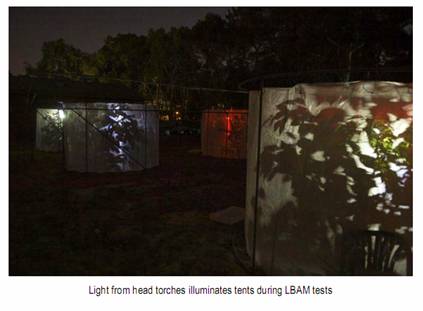
This is what Big Ag scientists were getting paid for during a 2008 visit in Australia, where "Field Cage Competitiveness Testing" for LBAM was being conducted: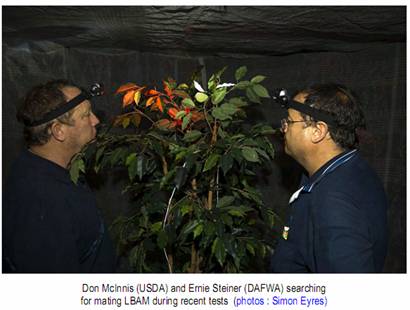
OTHER LBAM "PHEROMONE" FORMULATIONS
NEW ZEALAND TESTS
In addition to testing the twist ties and one of the Checkmate formulations used already (LBAM-F), the USDA partnered with two state owned biotech companies in New Zealand to test various chemical formulations of the "pheromone" as aerial applications, including SPLAT, the "pheromone" and permethrin mix we were told could be applied to utility poles and trees, and the "pheromone" flakes now approved for future use. Testing was regarding "efficacy" not safety. There is little if any information easily accessible on these formulations. All percentages of "active" ingredients refer to the "pheromone". It is said to be manufactured by Bedoukian.
The import
application states:
"The light brown apple moth pheromone has never been registered in the
United States due to the fact that there has never been a need for it
until now. USDA APHIS is currently seeking approval for the use of the
Hercon Product (LBAM Bioflake) and the ISCA Tech Product (SPLAT LBAM)
and expects authorization shortly. USDA APHIS will seek authorization
to use the Scentry product, depending upon the results of the
comparative efficacy trials in New Zealand."
Description
of the Test Program (pdf)
from the Application for approval to Import a Hazardous Substance to
New Zealand
"AMORPHOUS POLYMER"
Splat LBAM
(10% active 90% other ingredients)
Manufactured by ISCA
Technologies
"BIODEGRADABLE SOLID FLAKE"
This is
the new product approved for the
aerial portion of the LBAM program by the EPA after CheckMate was
pulled:
Disrupt Bioflake
LBAM
(15% active 85% other Ingredients)
Manufactured by Hercon
Environmental
"MICRO-ENCAPSULATED PARTICLE SUSPENSION"
NoMate LBAM MEC
(20% active 80% other ingredients)
Manufactured by Scentry
Biologicals, Inc.
The closest product fitting this description on the manufacturer's website is NoMate LRX MEC, for leafrollers, a category of moth under which the LBAM falls. It is another encapsulated product like CheckMate.
NoMate LRX
MEC MSDS
"Can cause irritation to eyes, skin, and respiratory tract…
Preexisting skin or respiratory disorders may be aggravated by
excessive exposure to this material… Carcinogen: Not known."
Note that this would be sprayed during hot California Summers, and in
wildfire prone areas: "Conditions to avoid: Excess Heat…
Unknown hazardous materials may be formed in a fire. Incomplete
combustion may lead to formation of carbon monoxide and/or other
axphyxiants."
NoMate is also used with an adhesive, such as this one:
Bio-Tac
Adhesive
"An Adhesive Product - Holds NoMate to Plant Foliage"
This particular product, which may or may not be completely different from the one they're testing, is made with polybutene, which is itself classified as a pesticide, and repels birds:
NEW PRODUCT IN THE U.K.
IMPACT ON HEALTH AND ENVIRONMENT SO FAR
HUMAN HEALTH
The health complaints experienced by Monterey and Santa Cruz county residents, who were exposed to CheckMate in Fall 2007, were consistent with the expected effects of the ingredients that were revealed to the public. Hundreds of people were reported to have been made ill by the aerial spraying, including an 11 months old baby who went into respiratory arrest, and several pets got ill, and some died, of identical symptoms as experienced by affected people. While the CDFA publicized that many of these reports are duplicates, the actual number of people injured is likely much larger, as many people have since explained that they did not make a formal report of their symptoms for various reasons, including lack of access to medical care.
List of health complaints - Fall 2007
Full report of 2007 health complaints
(8 MB pdf)
Many reports representing several people living under one roof. Also
including survey of impact on homeless residents of Monterey and Santa
Cruz.
Analysis of CheckMate by Dr. Lawrence Rose, M.D., M.P.H., recently retired senior Public Medical Officer for Cal-OSHA, and Occupational/Environmental Medicine practitioner at UCSF:
"These short term complaint symptoms are consistent with known toxicology scientific information of the ingredients of Checkmate... These ingredients include irritants, sensitizers, nervous system disrupters, endocrine disruption, allergens, and hypersensitivity induction. Long term health effects are also of concern due to the known induced mutations and suspected cancer risks of constituent chemicals."
Dr. Rose also points out that "Physicians are legally required to report diagnosed pesticide diagnosis; but in the two sprayed counties there was no systematic notification that included probably short term health reactions sent to health providers, first responders, emergency rooms, or all residents before the September, October, and November 2007 sprayings. This is a shocking disregard of human rights in any democracy."
Letter
to Joan Denton (OEHHA) and Mary-Ann Warmerdam (CDPR) (pdf)
by Michael Lynberg, a member of the public, who has taken it upon
himself to collect the health complaints,
notifying the Office of Environmental Health Hazards Assessment (OEHHA)
and the California Department of Pesticide Regulation that as of March
2008 the illness complaint count from 2007 has risen from 643 to 801,
with many more likely left unreported
Interview with Michael Lynberg about the health reports (YouTube video)
The
Day the Doctors Finally Read Toxicological Profiles of Pesticides (a
dream)
Maxina Ventura's response to OEHHA's 2008 disrespectful report which
suggests that all the sickness after Monterey and Santa Cruz sprayings
was not pesticide poisoning, even though they never spoke with anyone
who was injured, nor their physicians.
While OEHHA and CDFA downplay the results, the limited acute testing of some LBAM products, which was ordered by Governor Schwarzenegger, revealed serious safety concerns, including discolored organs in exposed test animals, and effects on the immune system. The LBAM products tested were CheckMate, SPLAT, NoMate, and Disrupt. The most commonly used application methods, the twist ties and traps, were not included in the testing.
OEHHA 6-Pack Acute Testing Review
Dr.
Ann Haiden's Commentary
about 6-Pack Tests
"There were worrisome findings that require explanation and
investigation, such as abnormal organs, one death and consistent
evidence of skin sensitization related lymph node activation in the
test animals. ... The consensus has downplayed the positive
lymph
node tests (LLNA), which evaluate early phase lymph system activation
by measuring lymphocyte proliferation. The positivity of this test,
rather than being questionable or of marginal importance, is more
likely a landmark finding for how environmental chemicals effect and
set the immune system on its future course. These findings may give
profound insights into how and why there is a persistent increase in
immune, neurological and inflammatory related illness in the
population."
Statement
regarding 6-Pack Tests by Stop the Spray, followed by detailed comments
by John Thielking
The Department of Pesticide Regulations has admitted that environmental
monitoring during the pesticide applications over Monterey and Santa
Cruz counties confirms substantial pesticide drift at least as far as
3.3 miles outside of the target areas. The DPR's deposition study also
reveals that communities were exposed to inconsistent doses of the
chemicals, because the capsules containing the pesticide "tend to
separate out of the mixture quickly and require constant mixing":
Deposition
study by the Department of Pesticide Regulations
Health
problems reported after aerial spraying interview with
Timothy Wilcox,
father of the 11 months old baby
Declaration
of Timothy Wilcox (pdf)
Father of the 11 months old baby
Declaration
of Steven Bruno (pdf)
who repeatedly developed symptoms when exposed to CheckMate persisting
in environment for 30 days after spraying
Declaration
of Gina Renee (pdf)
Acupuncturist who treated many injured people after CheckMate was
sprayed over Monterey
Homeless people were left unsheltered during the spraying, and even
more impacted than their housed neighbors.
Santa Cruz Mayor ignored pleas from homeless advocates prior to the aerial spraying
Santa Cruz Councilmember evaded questions about how to protect the homeless from further spraying
Also not being addressed by officials is how future spraying and other pesticide use will impact prisoners at San Quentin and other jails in the spray zones, as well as juvi lockups and psychiatric wards, let alone the treesitters at the University of California, and other vulnerable members of the community, such as children, pregnant women, the elderly, the already chemically injured, and others with compromised immune systems, all already under much physical distress.
The twist ties and traps have also impacted people's health, and we've been told by several people that they got ill from exposures by traps and twist ties, which contain the same synthetic "pheromone" as the aerial spray. Some of these exposures occurred at public meetings, to which government officials from CDFA and OEHHA brought these pesticide products, which is surely not an approved use of a chemical that has been declared permitted only in the context of the so-called LBAM "emergency" in the State of California, not for show-and-tell at public hearings.
Symptom Report Form from Maxina Ventura after sickened by LBAM "pheromone" traps and twist ties at office of the head of the Alameda County LBAM trapping program in April 2008
Another Symptom Report Form from Maxina Ventura after sickened by LBAM "pheromone" twist ties and other moth traps at a public hearing with CDFA and OEHHA in the chambers of the Sonoma County Board of Supervisors on July 8, 2008
Symptom Report Form from Isis Feral after sickened at the same meeting in Sonoma.
Prior to the meeting, Maxina Ventura contacted the CDFA and the Sonoma Board of Supervisors, requesting that the public not be exposed to pesticide products, such as twist ties or traps at the public hearing. Her mailing was confirmed received by public records requests by the Sonoma Board of Supervisors, as well as by OEHHA, where it was forwarded by the CDFA. The CDFA, in violation of the Public Records Act has yet to respond to our request for these same records.
Confirmation of Receipt of Access Request from the Sonoma Board of Supervisors with all attachments sent by Maxina Ventura
Confirmation of Forwarded Access Request from the Office of Environmental Health Hazard Assessment showing extensive forwarding within CDFA and OEHHA
In spite of the liberal forwarding of this request, and phone messages to LBAM Environmental Advisory Task Force member Ann Maurice, a large table with a variety of pesticide products, various traps with chemical lures, was set up outside the doors to the meeting by Ann Maurice, and Moira Sullivan, OEHHA representative, brought twist ties and a trap inside the crowded meeting chambers.
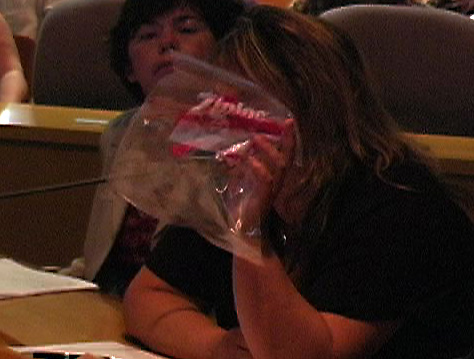
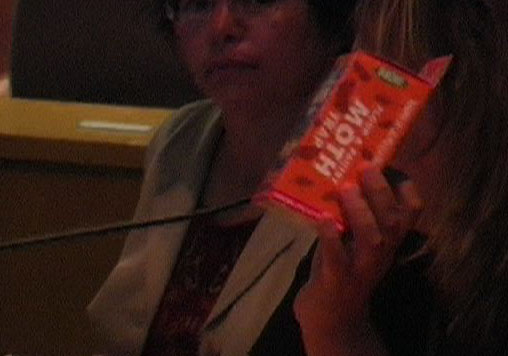
Moira
Sullivan holding up twist ties in a flimsy ziploc bag, and a
moth trap, at the meeting with the Sonoma County Board of Supervisors,
July 8, 2008.
When Maxina Ventura attempted to represent East Bay Pesticide Alert/Don't Spray California, combining speaking time also from Isis Feral, as recommended by Robert Leavitt of the CDFA when he refused us an opposing panel at the hearing, Mike Kerns, Chair of the Sonoma County Board of Supervisors, cut her off early. Even though he had said "Okay, Thank You" when Isis Feral ceded her time to Maxina Ventura, Kerns suddenly insisted such combining of time is not permitted, even though we have been told by members of the public who frequent these meetings, and by other Sonoma County staff, that such pooling of time is not uncommon.
Transcript of Maxina Ventura's Testimony Sonoma July 8, 2008
Adding insult to injury, Mike Kerns admonished Maxina Ventura, saying:
"I suggest that if you feel your health is at risk, whether it be real or imagined, you may leave these chambers."
So much for public access...!
PSYCHOLOGICAL TRAUMA
In addition to the health complaints, considerable emotional trauma was expressed by residents, who were kept awake by the planes flying low, back and forth over their homes:
It's Like the Fog, but More Toxic - Comments During and After the Spray
Psychological Stress Caused By LBAM Spraying - How Are You Doing?
ENVIRONMENTAL IMPACT
Declaration
of Konnie Mast (pdf)
whose cat suffered respiratory distress and was rushed to hospital and
recovered only slowly after treated with antibiotics
Kathleen Manoff's description of her dog dying
Summary Report: Post-Spray Effects on Animals and Pets (pdf)
In the days following the 2007 sprayings, residents reported that gardens previously full of birdsong and buzzing bees, were silent, as birds and bees avoided the sprayed areas long after. In the immediate aftermath, hundreds of dead birds were "mysteriously" washed ashore, including the endangered Brown Pelican. The Department of Fish and Game denies that there is anything in CheckMate that could possibly have stripped their weatherproofing off of the birds, or contributed to the worst red tide in decades, which was later blamed for the deaths of the birds. The red tide in turn was blamed on surfactants in the water. CheckMate contains several surfactants.
Moss Landing Mystery Spill - Discussion
Light Brown
Apple Moth Spray Causes Severe Red Tide (YouTube video)
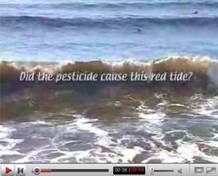
Surfers
in The Red
Red tide after spray made surfers in those waters sick, some with long
lasting respiratory effects.
Research
shows: Red tide forming algal blooms prefer to feed on urea from urban
runoff
CheckMate also contains urea. It rained after the aerial spraying, and
the storm drains lead straight to the bay.
Pilot
Error over homes, and Water Exclusion Zones (YouTube video)
Not all watersheds were excluded from the spray zones. The San Lorenzo
River was not an exclusion site. Pilots made known errors on four
separate days. The GPS system that was supposed to guarantee precision,
instead confirmed their errors.
Pilots Mistakenly Spray Outside Zones
CDFA
letter to property owners of areas sprayed accidentally (pdf)
Though the impacts are precisely what would be expected from exposure
to the chemicals that were dumped on Monterey and Santa Cruz, the CDFA
explains away these impacts as coincidental, that the quantity of the
chemicals was too small to possibly have caused them. But the CDFA
doesn't appear to have a handle on the measurements of our exposure. Is
it 33 microcapsules per square foot, or is it 114, or maybe 809,...?
Such widely divergent inconsistencies are not confidence inspiring.
Their goal, in any case, was 600-900 microcapsules per square foot. And while the CDFA argues strenuously that the capsules are not the size of particle pollution, which the American Lung Association considers any air borne matter between 2.5 and 10 microns, the manufacturer's own analysis admits that 1.2 % of the capsules are smaller than 10 micrometers (which is equal to microns). A square foot is not such a large area, and 1.2% of 33-900 can add up quickly.
Exposure
levels according to the CDFA (YouTube video)
PREPARATION, REMEDIATION, AND RECOVERY
HOW TO PREPARE
What ARE your rights?
Your constitutional rights about nearby pesticide use (pdf)
The Constitutional Rights That Exist To Protect You From LBAM Aerial Spraying
Nuremberg
Code - Directives for Human Experimentation
Relevant to CheckMate, the synthetic "pheromone" containing pesticide,
which has been untested on humans, and therefore its use over human
populations constitutes experimentation without consent.
So what about refusing access to private property for any of these applications?
According to the CDFA's Potential Questions & Answers (pdf) about the LBAM project:
"If I don't want applications applied to my property, how do I get out of it? Can the owner prevent application on private property?
No. In order to have a biologically sound program, CDFA/USDA cannot have a series of untreated refuges in which the moth can breed and re-infest treated areas, therefore the State of California can require access to private property in order to deal with a threat to the public."
However, the USDA's own Emergency Programs Manual (pdf) makes a good case for joint actions and a united front with our neighbors: One of several conditions under which an emergency program can be terminated is when "Sociopolitical opposition prevents emergency action" (page 91). As an example, during the CDFA's Glassy-winged Sharpshooter project, in the early 2000's the people of Northern California's wine country prepared to risk arrest to protect their families and homes from the government's threat of pesticide use against them.
Contact us if you are interested in organizing non-violent civil
disobedience and direct action training, and we will get you in touch
with trainers in your area, or provide our own:
beneficialbug@netzero.net
If this pesticide program continues, what can you do to protect yourself, your family, your pets, and your gardens from the pesticide applications?
Safety Precautions related to aerial spraying of CheckMate
Description of difficulties of cleaning up a garden after the spray, and safety precautions taken (YouTube)
Familiarize yourself prior to the spraying and other exposures with the various protocols you may wish to take in case you are poisoned. Print out the forms below and have them readily available, also look through the tips and suggestions for recovery and research the preventative steps also listed there that may be appropriate for you. None of the remedies here are meant as medical advice nor endorsed by East Bay Pesticide Alert/Don't Spray California, but are provided in the spirit of sharing resources.
If you are sickened by any of the CDFA's
pesticide applications - bring the following form to a doctor,
hospital, or clinic. Medical professionals are required by law to fill
out and submit this EPA form within 24
hours if an illness is known or suspected to have been
caused by pesticides:
Pesticide-Related
Illness Report (pdf)
Additionally, you
have up to 6 months to fill out a claim form for injuries or property
damages against the CDFA:
CDFA
Claim Form (pdf)
To ensure your reactions to the pesticides are reported, also send a symptom report to ReactionToSpraying@yahoo.com , or POB 1612, Pebble Beach, CA 93953, where the same grassroots efforts, which brought to light the injuries in 2007, will continue to collect health complaints:
Symptom Report Form (pdf) (MSWord)
updated from original used in Monterey in October 2007 to include all
areas and all parts of the LBAM trapping and eradication program.
Some suggestions to help with preparing for and recovering from the chemical assault, focused especially on nutritional and herbal support of the liver and immune system to boost its ability to help the body to detox:
Prevention
and Recovery Tips from Dr Randy Baker - Quick Reference (pdf)
A variety of tips from a doctor who treats many patients with chemical
injuries
What Does Pesticide Poisoning Feel Like? LBAM Spray Preparedness
Natural
Health Tips from Hope for Truth - Quick Reference (pdf)
A variety of tips from an activist
Get support and
share resources with other chemically injured and our allies on the
local Yahoo group:
Bay
Canary Grapevine
As a result of much public pressure the schedules and strategies of the LBAM program have been altered repeatedly, sometimes giving the illusion that the worst is over. But the program has in fact been expanded to ever larger parts of California, and quarantine boundaries are constantly widening. For the latest updates, please always double-check with the CDFA, unreliable though they are, and demand they keep the public informed of their actions.
Their precise actions will be unclear until CDFA posts the "operational plan" on their website which is expected to occur after the Final Programmatic Environmental Impact Report is certified anytime on March 4, 2010 or after.
The following information was compiled over the previous years of this program, and reflects some of the changes in CDFA's plans. Again, for the most up to date quarantine boundaries and government actions, please double-check with the CDFA:
Quarantine Manual as of April 29, 2009, with precise boundaries and maps
On June 19, 2008, the CDFA announced that it would halt the aerial spraying of urban communities. In a conference call Ag Secretary Kawamura clarified that the aerial spraying is only halted over "urban" areas, and only for this program, but may well become a tool in future eradication programs of other organisms. And CDFA Public Affairs Director Steve Lyle qualified the announcement by saying "At this point we will not be aerially spraying with moth pheromone in urban areas in the infestation zone".
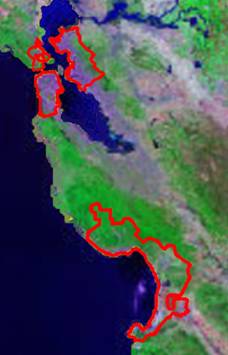
But what does "urban" or "populated" or "accessible by road" really mean? Bay Area and Peninsula cities and towns are surrounded by vast forests and parks, and if they are sprayed, drift is inevitable. And what about rural communities, whose agricultural neighbors expose them to a large array of chemical cocktails daily? Is it a victory if another chemical mix is added to their already heavy toxic body burden? As of July 24, 2008 there has been no clarification of the area still in the CDFA's spray zone. Comparing the map of the CDFA's prior plans with a satellite map, which areas look like "non-urban" and "forested" to you?
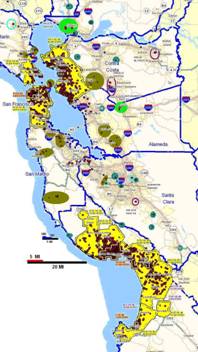 |
 |
The following was the plan of the CDFA prior to June 19, 2008. The ground applications are moving forward, as are likely some of the aerial applications:
The plan, once implemented, was scheduled to occur every 30 or 90 days for 9 months of every year, for at least 3-5 years. That adds up to being doused in chemicals a minimum of between 9 to 45 times over the next few years, from planes flying overhead at 500-800 feet, or reportedly lower, with chemical mixtures designed to be time released, and to persist in the environment in between spraying, to be dragged home on our shoes, clothes, our pets, and in our lungs, year round.
According to the
CDFA map
of proposed pesticide applications for 2008, the communities to be
SPRAYED BY AIR, which may also involve PERMETHRIN PAINTED on utility
poles and trees, though the details of this part of the program have
not been clarified, include the following
Beginning August 17, 2008 (postponed from June 1, 2008) continues to be the date of aerial spraying to begin, though which of the following areas remain in the spray zone is unclear, as is which of them and others will be in the drift zone:
SANTA CRUZ
COUNTY:
Aptos, Ben Lomond, Boulder Creek, Brookdale, Davenport, Felton,
Freedom, Mount Hermon, Soquel, Corralitos, La Selva Beach, Pajaro, Live
Oak, Rio Del Mar, Lompico, Scotts Valley, Capitola, Watsonville, and
the City of Santa Cruz.
MONTEREY COUNTY:
Pacific Grove, Pebble Beach, Del Rey Oaks, Moss Landing, Seascape, Las
Lomas, Elkhorn, Castroville, Prunedale, Boronda, Salinas, Marina,
Seaside, the City of Monterey, Carmel by the Sea, and Aromas (which is
also part of SAN BENITO COUNTY)
(postponed from August 1, 2008):
CONTRA COSTA
COUNTY:
Hercules, El Sobrante, Orinda, Pinole, San Pablo, Rollingwood, East
Richmond Heights, North Richmond, Richmond, El Cerrito, Kensington,
Canyon (and very close to spray zone: Lafayette and Rodeo).
ALAMEDA COUNTY:
Albany, Berkeley, Emeryville, Piedmont, Oakland, and the City of
Alameda.
MARIN COUNTY:
Sausalito, Belvedere,Tiburon, Marin City, Strawberry, Mill Valley,
Greenbrae, San Quentin (and close to spray zone: Larkspur).
SAN FRANCISCO City and County.
SAN MATEO COUNTY: South San Francisco, Colma, Broadmoor, Brisbane, San Bruno, Daly City, Pacifica (and close to spray zone: Millbrae).
It should be noted that as frequent as it sounds to be sprayed and exposed to drift once every 30-90 days, the reality is much worse: In the Fall 2007, those 3 aerial applications were executed over the course of 12 days: According to the CDFA report to the Legislature Monterey was sprayed September 9-13, and again with a different formulation on October 24-26. In Santa Cruz, they went back to the first formulation for November 8-9, in Prunedale on November 9, 11 and 12, and in Salinas on November 9 and 11.
The areas sprayed
by planes in 2007 were a total of 88,613 acres. Of the 571,259 acres,
892 square miles, established as the areas to be pesticided back in
February 2008, the areas to be sprayed by planes total 444,060 acres,
693.8 square miles.
For more details of what happened where, please see the deposition
study of the Department of Pesticide Regulations, which describes
environmental monitoring during the pesticide applications over
Monterey and Santa Cruz counties. It confirms substantial pesticide
drift at least as far as 3.3 miles outside of the target areas, as well
as reveals that communities were exposed to inconsistent doses of the
chemicals, because the capsules containing the pesticide "tend to
separate out of the mixture quickly and require constant mixing".
Deposition study by the Department of Pesticide Regulations
Hand spraying of Bt in Oakley and Napa in the summer of 2007 was replaced by twist ties, which were placed there and in Danville, San Jose, Sherman Oaks, and continue to be in Dublin, Pleasanton, Vallejo, and Mare Island. They are also being "deployed" in various counties in 2008.
TWIST TIES, beginning in March 2008, were underway or planned for:
MARIN COUNTY: San
Rafael, and Ross
SAN MATEO COUNTY: Half Moon Bay, Pescadero, Burlingame, San Mateo,
Belmont, Dearborn, and Loma Mar
CONTRA COSTA COUNTY: Moraga
ALAMEDA COUNTY: Union City, and Fremont
SAN FRANCISCO COUNTY: Treasure Island
SANTA CLARA COUNTY: Cupertino
SANTA BARBARA COUNTY: Carpinteria
The following are vaguely called "ERADICATION AREAS", and are currently listed as targeted for twist ties:
SOLANO COUNTY:
Vallejo
ALAMEDA COUNTY: Dublin
See the twist tie treatment maps for more detailed and updated information
The CDFA's initial plan was to also paint "MALE ATTRACTANT TREATMENT" on utility poles and trees in the following areas, but according to their official map of February 2008 those plans have been dropped, at least for now. Strangely, the previous map has since surfaced again, when it was presented to the City of Piedmont, and posted on the city's website as part of the CDFA power point presentation.
ALAMEDA COUNTY: San Leandro (which is closest to the spray zone), San Lorenzo, Cherryland, Ashland, Castro, Hayward, and Fairview
SAN MATEO COUNTY: Atherton, Woodside, North Fair Oaks, Menlo Park, and East Palo Alto; and in Santa Clara County, Palo Alto, Stanford, Mountain, Los Altos, Los Altos, Sunnyvale.
The CDFA has also
found moths in San Luis Obispo and Sonoma Counties, as well as Los
Angeles and Napa Counties, where the moths have supposedly been
eradicated. If more are found in those areas, or other areas being
monitored, pesticide applications may be expanded to include them.
In fact parts of Sonoma County are already under quarantine, and was slated to be treated with twist ties in June 2008, but neighborhood unity held off the applications, as many refused to have them placed on their properties.
In
2009 several
more areas in Sonoma and Napa Counties were added to the
quarantine, as well as in Yolo County.
Some Napa growers are ready to volunteer
to be the testing ground for the first irradiated LBAM releases. San
Benito County has also been added to the quarantine.
An updated map is to be released before further aerial pesticide applications are made.
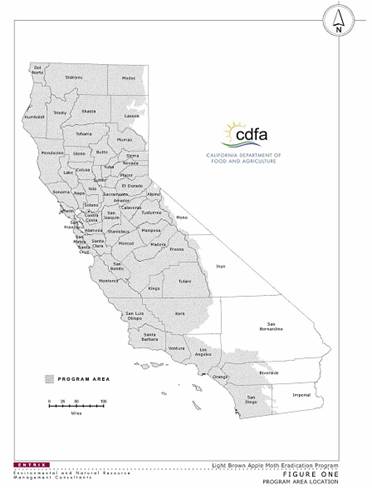
In July 2008, the CDFA announced the intention to expand the LBAM program to most of California:
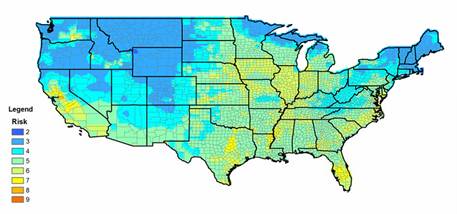
The United States Department of Agriculture, Animal and Plant Health Inspection Service (USDA-APHIS) is also conducting a National Survey, in 2007 still voluntary from state to state, in search of the LBAM. They estimate likely areas for future LBAM infestation across 80% of the continental U.S.
USDA schedules national survey to track invasive moth April 1, 2008
USDA-APHIS National Survey Guidelines (pdf)

Sign
up for email updates from the CDFA
but don't depend on them, or their postal announcements, as your only
source of information, as the CDFA has proved to be quite unreliable in
their communications.
Check CDFA's Twitter
page for updates
Also check weekly CDFA Situation Reports for changes
And CDFA Press Releases for public announcements
Contact the CDFA - Ask for clarifications, demand answers, let them know how you feel about this program
The CDFA Hotline 1-800-491-1899 (1 for english, 6 for LBAM, 0 for operator) lbam@cdfa.ca.gov
CDFA Public Affairs Director Steve Lyle (916) 654-0462 slyle@cdfa.ca.gov
Urgent Media (if Public Affairs office closed) (916) 502-7447
CDFA Secretary A. G. Kawamura (916) 654-0433 akawamura@cdfa.ca.gov
CDFA Integrated Pest Control - Dr. Robert Dowell (916) 654-0768 bdowell@cdfa.ca.gov
California
Department of Food And Agriculture
1220 N Street
Sacramento, CA 95814
CDFA and USDA LBAM
headquarters at Santa Cruz Fairgrounds (831) 763-5960
CDFA: Sean Hardy
USDA: Pat McPherren patrick.w.mcpherren@aphis.usda.gov
USDA Public Affairs Specialist Larry Hawkins (916) 930-5509 lawrence.e.hawkins@aphis.usda.gov
USDA Secretary Ed Schafer (202) 720-4623 AgSec@usda.gov
U.S. Department of
Agriculture
1400 Independence Ave., S.W.
Washington, DC 20250
For an example of how such a conversation might go, read the account of Don't Spray California's Chronic Effects Researcher: Maxina Ventura's talk with a clueless CDFA rep 2/08/08 (pdf)
Or her email exchange with Steve Lyle, who determined that the cost of informing her about use of LBAM pesticides in areas, which she and her children frequent, would be $3000
In Fall 2007 even city officials were largely taken by surprise by the aerial spraying, so calls to your own government's representatives may not be much more informative, but some municipalities are mobilizing against parts of the CDFA's program. Please contact them, find out what they've been told by the CDFA, what measures they're taking to protect the public, particularly our homeless neighbors, and ask them to take united legal and direct action against forced pesticiding by any method.
List
of areas to be pesticided and contacts for local representatives
This information was current in 2008. Some of the areas and
representatives have since changed. Please check the websites of the
local agencies, included in this document, for current representatives.
Also check CDFA
for current quarantine areas.
email
addresses from above list of contacts - for easy pasting
(most email programs allow you to send only a limited number at one
time)
Sign up for
Google News Alerts
Enter "apple moth," "lbam", "aerial spraying," "twist ties" or any
other relevant key words, plus your email
Sign
up for Yahoo! News Alerts
since some articles show up here that don't show up on Google
Search sites of groups opposed to LBAM program to do more indepth research of your own
Sign
up on the Stop Overhead Spraying Yahoo Group
Community Listserve for discussing, sharing resources and research, and
to organize collectively against the LBAM program, evolved into more
than just about aerial spraying.
So what could be so bad that the CDFA would take such a risk with the lives of California residents and visitors? They've declared an emergency to battle the light brown apple moth, a tiny Australian bug, which is claimed to inevitably eat us out of house and home, but has done no significant crop damage, nor is it likely that it will. In fact the LBAM's damage to crops is largely cosmetic. It is one of many manufactured crises that benefits the multi-billion dollar chemical industry, because it traps municipalities on a neverending toxic treadmill. The LBAM is certainly not an emergency, potential or otherwise.
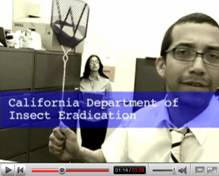
LBAM Takes
San Francisco (YouTube video)
Starring: Oakland-based performance crew headRush (Rosa
Esperanza Gonzáles, Xago Juárez and
Simón Hanukai) Written/directed/edited by: Patrick Wilkinson
(Special thanks to: La Peña Cultural Center, Destiny Arts
Center, and Centro Legal de la Raza)
THE MOTH

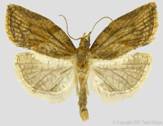
(actual size of light brown apple moth)
Unlike the CDFA would lead us to believe, the LBAM is not considered a significant threat in New Zealand, where it has been well established for over a century, but pesticides are, as is shown by plant experts Dr. Daniel Harder and Jeff Rosendale, who recently returned from New Zealand where they researched the issue in depth. Dr. Harder is the Executive Director of the UC Santa Cruz Arboretum, which includes plants from New Zealand and Australia, and is Adjunct Professor in the Ecology and Evolutionary Biology Department. Jeff Rosendale is a grower and horticultural consultant in the Monterey and San Francisco Bay Areas who specializes in plants from California, Australia, New Zealand, South Africa and Mediterranean Europe. They found that there "is no evidence of biological or environmental threat from LBAM in New Zealand":
"Reports of damage to crops prior to 2001 in Australia or New Zealand are from the era when organophosphate pesticides were heavily used to control LBAM (to comply with USDA requirements that no trace of LBAM be found). These pesticides eliminated LBAM's natural predators. Once organophosphate use stopped in 2001 and natural predator populations rebounded, New Zealand's LBAM problem was greatly reduced to its current, insignificant level."
"Under the organophosphate spray regime, LBAM was a problem of greater significance than it is today, and all pests were more difficult to control and became increasingly hard to keep in check. Populations of insects, including LBAM, developed resistance to the organophosphate formulation." - "...experts also question the efficacy of bacillus thuringiensis (Bt) against LBAM. Bt can also have a detrimental effect on beneficial insects."
"The requirement that California nurseries use chlorpyrifos [sic] sets California up for failure of long-term LBAM management and management of future pests that would otherwise be controlled by natural predator species that will be compromised or eliminated by chlorpyrifos [sic] use. This and other highly toxic treatments need to be discouraged or prohibited in commercial nurseries."
LBAM Status report from New Zealand by Dr. Daniel Harder and Jeff Rosendale (pdf) March 6, 2008
Harder and Rosendale respond to CDFA's criticism of New Zealand report (pdf) April 2, 2008
The report further notes, that "According to New Zealand Ministry of Agriculture and Food (MAF) and Department of Conservation (DOC) experts, LBAM does not build up in any one host in the wild and has never posed a threat to native forests. Natural predators keep LBAM in check, and it is so rare in the wild that it requires a true expert and meticulous searching to even find any sign of it."
Yet U.S. tax dollars, set aside for this pesticide program, are being wasted to test their toxic chemical mixtures on this elusive LBAM population in New Zealand. On February 17, 2008, The New Zealand Press Association reports that "Two state-owned science companies in New Zealand are extracting some of that cash in return for expertise Hortresearch has in use of pheromones -- sex attractants -- to disrupt mating behaviours by pest insects, and expertise forestry research company Scion has in precision aerial spraying."
NZ forest provides laboratory for pheromone trials NZPA 2/17/08
Application to Environmental Risk Management Authority New Zealand to import various chemical formulations of the "pheromone" for field trials
In Hawaii, where LBAM has also been established for more than a hundred years, it not only is not considered a significant pest, but may even be considered beneficial, as a control measure for invasive gorse and blackberry, according to the Hawaii Department of Agriculture.
Hawaii Department of Agriculture Press Release in response to USDA Quarantine May 2007
According to UC Davis entomologist James R. Carey, the moth has probably been in California as well for "a very long time prior to its discovery and it's probably far more widespread than currently delineated".
And just how did the CDFA determine the number of LBAM in California? The CDFA's 2007 Report to the Legislature (pdf) states that part of their research objective that year was to "Develop an effective DNA fingerprint and identification technology for LBAM":
"In California there are native moths in the same family as the LBAM. Since LBAM is not known to occur in California, a comprehensive key for identifying the larvae does not exist. Therefore, if larvae suspected of being LBAM were collected from commodities from within the quarantined area, they could not be sold until the commodities were treated with an approved treatment. To remedy this problem, the protocols for the molecular diagnosis of LBAM larvae were developed by the USDA, Pest Detection, Diagnostics and Management laboratory, in consultation with the Department's Plant Pest Diagnostics laboratory. By June 18, 2007, the Department was able to identify LBAM larvae using DNA sequencing."
The CDFA's claims that no LBAM were found in 2005, and their claims of infestation in 2007, followed by the quarantines, were all established before this "effective identification technology" was developed...
The LBAM Program - A Fraudulent Program by Glen Chase, Professor of Systems Management, specializing in Environmental Economics and Statistics
LBAM
in California - The True Story: Summary & References
through June 19, 2008
Prepared For the People by Professor Glen Chase
POTENTIAL ECONOMIC IMPACT OF THE MOTH
LBAM - Implications for California
Agriculture (pdf)
Dan Harder, Jeff Rosendale, Roy Upton, Teresa Aquino, and Kenneth
Kimes, plant experts and nursery owners show that the eradication
efforts and quarantine have far greater implications for Agriculture
than the moth.
As paraphrased by the Monterey Herald, Carey has indicated that "the state has to show it is making efforts to eradicate the pest, even if the efforts aren't effective", that "the primary economic impact of the moth is likely to be the result of trade restrictions from imposed quarantines, and not crop damage caused by the moth." Carey said that "to acknowledge that they're established is to unleash economic consequences that are even more devastating than the spread would cause,…to acknowledge the truth is to trigger these embargoes and quarantines that are absolutely devastating, so they're always playing this game that it's 'eradicable' "
Dr. Carey's Presentation to the State Senate Environmental Quality Committee (pdf) March 2008
UC Davis Experts Letter to the USDA
(pdf) May 2008
Putting the eradication program in question as not based in science.
The USDA/CDFA LBAM pesticide project has nothing whatsoever to do with securing our food supply, nor with environmental protection, nor with public health and safety, but everything to do with the politics of trade between profit hungry multi-national corporations, at the expense of the public. What the government agencies are defending here is not our food supply nor our ecosystems but capitalist interests in international trade. The LBAM is no threat to us, but it is a threat to a complex system of agro-business trade agreements, formed not to safeguard human or environmental health, but rather to guarantee supremacy in the marketplace for the U.S., specifically to crowd out competition. The LBAM quarantine is a tool of big agro-business to achieve this supremacy.
UC
Berkeley Agroecology Professor Miguel Altieri explains:
"Free trade,…most of the western countries are
involved, basically functions on restrictions to trade, and one of the
restrictions to trade is quarantine pests."
"$75 million, the USDA is gonna devote for…the eradication, which is actually an ecological illusion: It's totally unsound to do that, because you cannot eradicate organisms. …$75 million is actually 20 times more than the budget that the University of California devotes to organic farming. If we had $75 million to do research on organic farming alternatives, we wouldn't have to worry about this pest or any other pest."
"So who is afraid of the pest? It's basically…two groups: One is agri-business and the other is the University of California, which serves agri-business."
Larry Bragman, member of the Fairfax town council points out that Mexico's quarantine demand is subject to change, depending on the very sort of scientific study Harder and Rosendale conducted in New Zealand. "If the NAFTA quarantine demands are withdrawn, California farmers will not face significant economic losses from this moth. The health and safety of residents should not be subordinated to U.S. trade policy."
Larry Bragman: Will U.S. trade policy again trump public health?
In a public vow to "work vigorously to stop" the spray program, Robert Lieber, Mayor of the City of Albany, one of the cities on the list to be sprayed aerially, and Registered Nurse with extensive experience in respiratory care, who provided emergency triage and healthcare after many toxic chemical accidents and releases, including the Chevron spill, declared that "we cannot risk public health to protect business interests." Beyond merely this one, of an endless series of pesticide programs, he pointed out that "eradication is no longer a realistic pest management goal in view of world trade and global warming, which will continue to introduce new pests to California. We cannot continue to risk human and environmental health by spraying for every new bug".
Canadian
Food Inspection Agency Quarantine
Note it is in response to ("intended to complement and supplement")
USDA's own Federal Domestic Quarantine Order.
Statement against CDFA's LBAM program by City of Albany Mayor Robert Lieber, RN (MS Word)
ECONOMIC IMPACT OF THE PESTICIDE PROGRAM
ORGANICS
Organic farmers are bearing the brunt of the burden of the CDFA's pesticide campaign. As Steven Munno, an organic farmer from UC Santa Cruz, described at our community brainstorm in San Leandro in February 2008, the LBAM, which is present at the farm on which he works, is not doing significant damage to the crop, but the government's wasting time with paperwork better spent farming, and the demands to constantly handle crops in search for the LBAM, is doing the real damage, especially to strawberries.
Federal and state inspectors to descend on Santa Cruz County in search of moths May 11, 2007
What happens if nursery owners refuse to comply with spraying pesticides on their plants?
Blue Bamboo nursery forced to close June 27, 2007
Invasive Procedures March 18, 2008
As another farmer
states on Michael Olson's MetroFarm
forum:
"It's the possible spraying of my organic farm with the so-called
"inert ingredients" that I object to. Those chemicals don't belong in
the FOOD CHAIN … If my farm's products are no longer
"organic", certifiably or otherwise, then my livelihood is damaged! WHO
DO DAMAGED FARMERS SUE FOR DAMAGES? What person or agency? ... As for
Organic Certification, that is beside the point. I could not sell
contaminated animal products in good conscience, especially to those
who want or need unadulterated food for preexisting reasons."
The California Food and Agriculture Department is clearly not concerned about organic farmers, as organic standards are in the process of being diluted further, and many of us will be enforcing our own embargo once the spraying starts, on all our own locally grown foods, which we know will no longer be organic, no matter what the label may be allowed to claim. Sure, imagine the economy with a negligable risk of loss of those obscene conventional agriculture profits... But imagine also the impact of people who previously bought local now buying elsewhere.
Organic's
Organic Metro Active on the natural food industry seeking
organics grown outside the spray zones.
Even sharing and bartering of homegrown food has been made illegal by
the quarantine, as can be seen in this recent example of the Veggie Trader
website prohibiting quarantined neighbors to post their
harvests:
"San Francisco Bay Area Residents, please note:
Because of a comprehensive produce quarantine in place for most of your
region due to the light brown apple moth, we unfortunately can't allow
items under quarantine to be posted on Veggie Trader. For more specific
information on the quarantine and the areas affected, please refer to
the California state department of agriculture website."
The Light Brown Apple Moth vs. Veggie Trader
VISITORS & RESIDENTS
Imagine people dreaming of moving here for the clean air, thinking the better of it, and seeking real estate elsewhere. Imagine current residents packing up and leaving the area.
Moving Because of LBAM Spray - California's Refugee Problem
Ishana's Farewell to Santa Cruz
Craig's List Ad
Seeking Housing Outside the LBAM Program Zone
Marin Realtors disclosed the possibility of pesticide spraying to potential home buyers
While
the Marin Association of Realtors initially opposed only the aerial
spraying, the organization has since come out in opposition to the
entire LBAM Program.
Imagine travel advisories that the San Francisco Bay Area and Monterey Peninsula are no longer safe vacation spots. People from every continent have signed the petition against the spraying! Imagine athletes adding California to the list of places, like some olympians in Beijing, where they refuse to compete because of pollution. Discussions and Eco-alerts have already been posted on Fodor's community forum about the safety of visiting the spray zones.

Our Own
Pesticide Alert Travel Advisory - Letter to LinuxWorld Conference
(pdf)
Melinda Kendall, is the Vice President and General Manager for the
LinuxWorld conference, which is scheduled at Moscone Conference Center
in downtown San Francisco August 4-8, 2008, the week that the spraying
was likely to begin there, before the recent postponement of the aerial
applications.
Our Especially
Urgent Pesticide Alert Travel Advisory - AIDS/LifeCycle Ride Campers
(pdf)
On June 1, 2008, the night the spraying was to begin again over the
Peninsula, several hundred HIV+ bicyclists of the AIDS/LifeCycle
Ride, a large fundraising events for AIDS services, will be camping in
Santa Cruz that night, along with a few thousand other riders and
volunteers. There was grave concern for the safety of the many
participants who are particularly at risk because of their compromised
immune systems, as can be seen on the petition to Stop the Spray (page
<14,100).
LBAM Aerial Spraying on California's 315 Million Tourists
Spraying to fight moth in California could have economic impacts
LBAM: Economic Impacts and Solutions (pdf) a CASS Research Summary
The Real
Cost of LBAM Aerial Spray (YouTube video)
Estimates that the impact on tourism, real estate, and other industries
in the spray zones, is in the billions of dollars, far outweighing even
the most hysterical estimates of possible LBAM damage by the USDA and
CDFA. This video was also seen on a tourism
website.
LIVELIHOOD
Health
Math of the Moth Spray - A People's Risk Assessment
Of approximately 7 million residents in the spray zones, how many thousands of women, children, elders, chemically sensitive and immune deficient individuals, are at particular risk from exposure to the spray?
Considering these estimates, and the hundreds of health complaints already, imagine a disabled workforce, sickened by the chemical cocktails unleashed on our cities, along with the cost of the resulting increase in needs for social services. The real emergency is not the LBAM. It is this pesticide program that's the emergency, that will destroy public and environmental health, and devastate our local economies.
CAUSE OF THE EMERGENCY
Industrial agricultural practices are at the heart of this emergency. Mono-crops and chemical use, which exploit, rather than nourish the soil and its creatures, cause an ever revolving crisis of vulnerability to so-called pests. Organic farms of great biodiversity, which more closely mimic naturally evolving ecosystems and maintain their own balance, are not significantly affected by these "pests".
In an interview on Food Chain Radio (mp3) with Michael Olson, Dr. Robert Dowell, CDFA's entomologist for the LBAM program, states that "exotic pests are the ones that cause the majority of the crop losses on what are in fact exotic crops also".
So they are growing exotics on one hand, and eradicating them on the other. They bring exotic crops here themselves, but don't want the exotic bugs that go along with them. They try to pick and choose which exotics they want present in our native ecosystem and which not. And now, after decades of destructive agricultural practices, and quite literally waging war on nature, the chickens, or more accurately, the pests, are coming home to roost.
After 9/11 the Department of Homeland Security became responsible for keeping exotic pests from crossing borders into the U.S., absorbing a large portion of USDA employees, with agriculture gaining an increasingly obvious militaristic image. To those familiar with the history of pesticides, this is not surprising. Agent Orange, napalm, and sarin have gone down in history, and nowadays pesticide containers are considered weapons of mass destruction, and used as an excuse to bomb Iraq. After Hurricane Katrina it was the Air Force which dumped the organophosphate naled on the survivors in New Orleans, injuring them further in the name of protecting them from mosquitoes. Even the planes they used to spray the California Peninsula against the LBAM in 2007 belong to a company whose primary market is national defense.
Chemical
warfare over Bay Area cities - Who's afraid of the light brown apple
moth?
A summary of the politics of the LBAM and other pesticide programs,
including the militarization of agriculture, by East Bay Pesticide
Alert/Don't Spray California in Berkeley-based Anarchist Newspaper
Slingshot
But their "biosecurity" isn't working, because the world does not revolve around human industry, but around nature, and nature interacts, even across human boundaries.
Four points out of the CDFA's five point Mission Statement are directly related to international trade, addressing "invasions" of "exotics", promoting California's produce here and abroad, ensuring an "orderly" marketplace for it, and building coalitions to meet industry needs.
Some of the protests against the LBAM program have focused on lobbying for legislation against aerial spraying in urban areas, but what constitutes the boundaries of "urban" vs "rural" in the category systems of big business is a slippery slide, and many unincorporated areas, in which thousands of people reside, may not be considered urban at all. And what of the residences, schools, hospitals, and jails, neighboring agricultural fields? Are the people living there any less entitled to health and safety? Workers are dying in the fields, as are the neighbors next door to them. In the cities we have the luxury not to pay attention to them. Out of mind, and out of sight, as we harvest our foods in supermarkets.
But the agriculture and pesticide industries are MULTI-BILLION dollar industries, closely intertwined, and jointly responsible for millions of injuries and deaths, causing cancers, respiratory illnesses, neurological disorders, reproductive harm, immune system vulnerabilities, impacting ALL systems of our bodies to varying degrees. It isn't a question of spraying residential vs. agricultural areas. They've expanded their toxic campaigns into the cities long ago (Caltrans, and most city's Public Works agencies, just to name two of many many many such agencies, are using toxic herbicides daily all around us). All the many body burden studies that have been done over recent years show that NONE of us, no matter where we live and no matter how healthy our lifestyles, has been able to escape toxic exposure.
We are not just dealing with this one assault on us. Even if we win this one, the "pest of the month club" will keep coming back, again and again, maybe by plane, maybe by truck, maybe with backpacks, and subtle ways we have yet to recognize, because they profit obscenely from it. Yes, we must fight now, against this particular assault, but please, do not take this fight out of the larger context in which it is happening. The only viable alternative to what is happening is a COMPLETE change of attitude towards these so-called "pests", or else any living thing these folks don't like can be used as an excuse to douse us in poison. There are endless, well-established, non-toxic ways to control nuisances around homes and gardens, which should be highlighted, rather than playing into the chemical industry's hands. But while we waste our breaths on suggesting feasible alternatives, which would give people jobs, protect the environment, make no one ill, often spending less money than they are offering up for their programs, there is a reason why they don't use the money for such alternatives: just like with Mosquito Abatement Districts, funding for these programs is predicated upon pesticide use.
To name just a few of CDFA's pesticide programs, in the early 1990's it was the Phylloxera (which the CDFA can thank for its beginnings in the small State Board of Viticulture, established around this root louse in 1880), in the mid-late 1990's it was the Blue-green Sharpshooter (BGSS), in the late 1990's and early 2000's it was the Glassy-winged Sharpshooter (GWSS), now it's the Light Brown Apple Moth, with the Gypsy Moth in close pursuit. After all those tax dollars and years of toxics dumped onto people, wildlife and the environment, all those "pests" are still around, getting it on with the uneradicated Medfly, the epitome of the CDFA's devastating and failed eradication programs. And while people are the ones dropping like flies, from immediate impacts like asthma and other respiratory distress, and longterm effects like cancers, and disabling neurological and immunological illnesses, often resulting in equally crippling poverty, CDFA officials are accumulating their nest eggs from a career of poisoning the public.
Financial Statement - Fiscal Year 2007-08 Budget - for the LBAM project
Jim Rains, the Staff Environmental Scientist to whom many of us sent comments for the CDFA's LBAM Draft Environmental Impact Report (EIR), also worked on the GWSS.
Steve Lyle, Head of Office of Public Affairs, displays the same callous attitude pushing the LBAM program now, as he did during the GWSS program.
Peter Kurtz, Senior Medical Coordinator has had a long career of ignoring people's health concerns during the Medfly, GWSS, and now the LBAM program. In 2003, during the Mexican Fruitfly program, Kurtz was asked why residents were advised to stay indoors during the spraying of spinosad, also in the CDFA's to stay indoors during the spraying of spinosad, also in the CDFA's arsenal for the LBAM, and to wash sprayed foods, if there's nothing in it that is harmful. His answer was a deflective counter-question: "if you can take such precautions why not do so?
Bob Wynn, the State Coordinator for the BGSS and the GWSS, appears also to be consulted for the LBAM. In fact in April 2007, Bob Wynn, coordinator of the Pierce's Disease program, briefed members of the CDFA's PD/GWSS Board and Advisory Task Force about CDFA's LBAM plans, and LBAM traps are being "piggybacked" along with the GWSS trapping program.
Since the 1950's, when "better living through chemistry" became the slogan of "progress", the chemical industry has made itself indispensable by any means necessary, trapping us in a cycle of dependence on toxic chemical concoctions for day to day tasks such as gardening, and cleaning ourselves and our homes, which remarkably civilization had managed to survive without for centuries prior. Over the course of about 60 years, the chemical industry has convinced people that without these chemicals we'll go extinct, when the precise opposite is true. These chemicals are killing us, and the people who run the industry know it too. As their profits are reduced by an increasingly ecology-minded public, they roll out the public relations and marketing firms to manufacture our consent, attempt to greenwash their image with "kinder, gentler" pest management "tools" that merely kill us a little slower, and politely threaten us with starvation and even worse poisons than the ones they're using:
On Food Chain Radio, Dr. Dowell, perpetuating the scarcity myth, threatens us with hunger caused by "exotic pests" such as the LBAM: "Insect pests are one of the major competitors we have for food supply ... So basically take a look at your food supply in your grocery store and figure out that as good as that looks, you are competing with exotic pests for that food."
And CDFA Secretary A.G. Kawamura, on the same radio program, greenwashing CheckMate as an exciting new tool of sustainability, threatens us with worse pesticides if we don't comply: "ultimately they're going to be exposed to more things in the future, because we didn't take care of this pest ... It's a decision people need to make."
But the CDFA thugs have made it very clear what rights they believe we have in this matter. As Public Relations Director Steve Lyle said: "The authority rests with the state. There is no vote."
He couldn't have made it any clearer, yet people continue to negotiate with these thugs, bargain with the abusers. The CDFA's threats to use worse is having many ready to compromise in a panic, and while we are happy to unite to stop the aerial spraying, we also stand opposed to any and all use of toxics, always and unwaivering. How can relevant change in pesticide policies ever come when we settle for "winnable" fights that leave large segments of the population sick, dying, and running for their lives? Such compromise is a luxury many of us already poisoned and vulnerable don't have. How much of a victory is it, when big national non-profits like PANNA oppose aerial spraying, but call for toxic twist ties, and are gladly exploited by the CDFA to further "green" their image by using PANNA's own words to defend their position, while those of us actually living in the affected areas suffer further?
Don't Spray California does not compromise about people's health, nor do we ride home victories on the backs of people too sick to fight for themselves. When under attack, we don't politely beg for our rights, but defend them. We say No. Enough! We demand they clean up their own soil, which they polluted themselves. We say no more toxic chemical use by any method (planes, hoses, paint guns, danglies,...), anywhere (whether urban, rural, corporated or incorporated, or prison towns, and certainly not our homes)!
THE PUSHERS OF THE PESTICIDE PROGRAM
This is not the first pesticide program. Nor will it be the last. Programs like these are fundamental to the funding mechanisms upon which Agricultural and Vector Control Departments depend across the country.
As we explore these programs, we realize there are basic, repeatable questions to ask, and expect to have answered:
Who begged for
help?
Who called the emergency?
What constitutes an "infestation"?
What are the precise plans of execution of the program?
Who are the point people, the players involved in this drama?
Who is funding the program - the state, the feds?
Was the LBAM ever actually declared an official state of emergency?
UNITED STATES DEPARTMENT OF AGRICULTURE (USDA)
Mini
Risk Assessment - University of Minnesota 2003 (pdf)
The USDA's Animal and Plant Health Inspection Service based its
decision to establish a Technical Working Group for the LBAM, on this
report, which estimates habitable areas for possible future LBAM
infestation across 80% of the continental U.S
Official Pest Alert March 22, 2007
Federal Domestic Quarantine Order May 2, 2007 (pdf)
Canadian
Food Inspection Agency Quarantine
Note it is in response to ("intended to complement and supplement")
USDA's own Federal Domestic Quarantine Order.
Mexico's LBAM Phytosanitary Advisory
Note
it specifies that it is "Unnecessary to say that, the present
phytosanitary conditions may be modified or harmonized whenever we have
more technical and scientific information regarding E. postvittanna, as
well as we receive more information about the evolution status of this
pest in the United States."
PATRICIA WIGGINS
On September 7, 2007 the Light Brown Apple Moth Act of 2007, authored by California Senator Patricia Wiggins, passed the Senate, was immediately approved by Governor Schwarzenegger, and filed with the Secretary of State. It declares the LBAM a "clear, present, significant, and imminent danger", and states that "This act is an urgency statute necessary for the immediate preservation of the public peace, health, or safety within the meaning of Article IV of the Constitution and shall go into immediate effect."
Two days later, on September 9, aerial spraying began over Monterey.
The Light Brown Apple Moth Act of 2007 - Wiggins' SB 556
According to Wiggins' office, SB 556 is "patterned after the state's Pierce's Disease/Glassy Winged Sharpshooter program", another forced pesticide program also enabled by one of Wiggin's bills, AB 1394, when she was a member of the Assembly in 2001.
AB 1394 established the Pierce's Disease and Glassy-winged Sharpshooter Board, to be controlled entirely by the wine and grape industries, to assess their own tiny contributions to an otherwise tax payer funded program, and to spend those funds on any toxic assault on people's homes of their choosing. Pat Wiggins loyalties are well established, as she receives a vast amount of contributions from the wine industry pushed a recent bill to allow more "wine-related fundraisers", and her AB 1394 was signed into law by then Governor Gray Davis at a vineyard "as about 100 industry representatives looked on".
CALIFORNIA DEPARTMENT OF FOOD AND AGRICULTURE (CDFA)
CDFA/USDA
Powerpoint presentation on LBAM Program - January 2008 (open
read only in PowerPoint)
Even though the map of areas to be pesticided was changed February 15,
2008, adding predatory wasps to the program, and inexplicably
eliminating two large areas of ground applications previously
considered part of this "emergency", on March 3 the CDFA presented the
old map in a power point presentation to the City of Piedmont, which
posted it on the city's website.
CDFA/USDA Powerpoint presentation on LBAM Program - February 2008 (PDF)
A.G. KAWAMURA
CDFA Secretary A.G. Kawamura, appointed by the governor, donated $21,200 to Schwarzenegger. He is former chairman of the Western Growers Association, who have stood in opposition to recent legislation to protect farm workers and the environment, in essence an organization opposing regulation of the agriculture industry. Now, as secretary of the CDFA, he is in charge of making the regulations himself.
Kawamuras
Decry Regulation, Not Development
His concern for his employees' wellbeing is truly touching: He's more
concerned about the expense of the meager health care benefits only a
small percentage of California farm workers actually receive, and which
are particularly urgently necessitated by the rampant agricultural
pesticide use they are exposed to daily. He claims "his workers'
compensation insurance and healthcare costs have soared, threatening
his financial viability".
Of course buying a politician is always in the budget:
Oops! I Appointed a Special Interest
To ensure his english literature degree doesn't go to waste, he writes a particularly fine piece of fiction:
A.G. Kawamura: Ag secretary protects farmers, environment
Ag Secretary A.G. Kawamura's defends dousing people with pesticides
Kawamura debunked - Albany Mayor and Registered Nurse Robert Lieber's response: Resign!
SUTERRA
Suterra
The manufacturer of CheckMate, "the leader in biorational pesticides"
Suterra's
letter to Indymedia
Demands that information about a "secret" ingredient in the CheckMate
OLR-F mating disruption pheromone be removed from public view on
Indybay's independent media site.
Ask Suterra what's in their products, and it's unlikely you'll get much of an answer:
Email exchange with Suterra about the ingredients of their LBAM traps
Suterra's Response to a concerned person who asked whether CheckMate contains nano-technology
Suterra
is owned by Stewart Resnick
Besides Suterra, Stewart Resnick, and his holding company Roll
International Corporation, also own Paramount Farming ( pomegranates,
almonds, pistachios, including Sunkist Almond Munchies and Almond
Accents, Sunkist Pistachios, Everbody's Nuts Pistachios) and Paramount
Citrus (largest citrus grower in California, California Cuties
clementines, and supplies 20% of Sunkist's citrus), POM Wonderful
(pomegranate juice), Del Rey Juice Company (frozen juices), Fiji
(bottled) Water, Teleflora (cut flowers delivery service), and Bundy
Properties (commercial real estate), S&J Ranch Management, and
50% of GCE Mexico I, LLC (biofuels).
Resnick
wages war on Honeybees
Instead of admitting to mistakes in their own growing practices,
Resnick's lawyer threatens beekeepers to keep bees from pollinating
their seedless mandarins.
Fiji
Water: Spin the Bottle
Does Fiji Water legitimize a dictatorship? "How did a plastic
water bottle, imported from a military dictatorship thousands of miles
away, become the epitome of cool?"
Not only does Resnick bottle Fiji's underground water in disposable plastic bottles to be shipped far across the world to be consumed as a luxury item for a steep price, while the people of Fiji worry about access to safe drinking water, in California a closed door deal in which the agriculture industry acquired the Kern Water Bank, originally established as an emergency reservoir for the public, of which Resnick now owns 48%, causes obscene "irrigation sprawl":
Water Heist: How Corporations are Cashing in on California's Water (pdf)
Resnick is also raking in huge profits from a related crooked water deal aimed at environmental protection, which in fact has contributed instead to a devastating decline of fish populations in the Delta, including the endangered Delta smelt.
Pumping water and cash from DeltaIn the midst of a drought, a water shortage of our own in the Bay Area, how much water would be wasted to mix the CheckMate for this program as originally planned?
CheckMate Spray and Water to Mix It (pdf)
POM
Wonderful Agrees to Stop Testing on Animals
Mice and bunnies may finally be safe from Resnick's cruel animal
testing for POM Wonderful. When will his other company, Suterra, stop
experimenting on human animals without their consent?
In April 2008 Resnick entered into a 50-50 joint venture as a subsidiary of Global Clean Energy Holdings, Inc., formerly Medical Discoveries, Inc., which had dabbled in pharmaceuticals, and is now involved in growing biofuels. A few days after the partnership was announced, the subsidiary, GCE Mexico I, LLC, acquired 5,000 Acres in the Yucatan in Mexico, where they plan to plant 4 million jatropha trees for biofuel. Unsurprisingly, as Resnick once again attempts to greenwash his greed, his jatropha venture does not come without controversy. Labor concerns abound, as the tree has no predictable harvesting seasons, making it exceedingly labor intensive, likely resulting in cheapening labor, while the work itself is dangerous, as the seeds and leaves are toxic, and may injure workers and neighbors near production facilities.
Labor Intensive Jatropha Not a Magic Bullet
In India, the damage of jatropha plantations has already been well established. According to a study by Dr Vandana Shiva and Manu Sankar, Biofuel Hoax: Jatropha and Land Grab jatropha cultivation for biofuels has displaced tribal people, and lead to biopiracy by one of a handful of competitors of GCE Mexico. But these social and environmental justice concerns don't stop researchers there from developing genetically modified varieties and planning extensive plantations throughout India.
Resnick
donated $144,600 to Governor Schwarzenegger's re-election campaign
Arnold Schwarzenegger is quoted as saying "Any of those kinds of real,
big, powerful special interests, if you take money from them, you owe
them something"
Pesticide maker owned by political donor San Francisco Chronicle
The planes they use to spray are chartered from Dynamic Aviation, who consider themselves to be "Partners Safeguarding Earth", one of whose primary markets is national defense, and who are involved in "intelligence, surveillance and reconnaissance". Their home port is in Virginia, but they also have offices conveniently located in Central America and the Caribbean.

NEW ZEALAND BIOTECH
The two New Zealand biotech companies involved in testing of the aerial spray to be used in California:
HortResearch's
"Biosecurity"
Pest control mimicks homeland security - improving "border biosecurity"
Max Suckling, a member of the Technical Working Group (TWG) advising the CDFA, is a former president of the New Zealand Plant Protection Society (NZPPS), whose corporate membership is full of large manufacturers of pesticides, such as Dow, Du Pont, Syngenta, Bayer, BASF.
Scion's
"SafeSpray Manager" (pdf)
Aerial pesticide application risk assessment software - leaving our
safety to computers
Eckhard Brockerhoff, who applied for the "pheromones" to be imported to New Zealand for testing of which formulation the CDFA is going to use, and who is also a member of the TWG, is the former website editor of the NZPPS
Description
of the Test Program (pdf)
Application for approval to Import a Hazardous Substance to New
Zealand, prepared by Scion (New Zealand Forest Research Institute Ltd).
They've managed to convince native people of New Zealand who own the land they're conducting their tests on that what they're doing is harmless. Knowing what we've learned over the last few months, they likely achieved such agreement with disinformation: "The land area we plan to use is on a property owned Ngai Tahu, who have been informed in detail about the experiment, and have given us permission to proceed as planned... No adverse effects on Maori and their cultural and traditional values have been identified. Their support for this trial suggests that a benefit has been identified (such as the control of a pest negatively affecting the pine forest on their land)." We also learned that lack of representation is quickly interpreted as consent.
PORTER NOVELLI
The CDFA, desperate to convince the public not to organize against the pesticide program, hired the Public Relations firm Porter Novelli, which was started by two men who helped get Nixon re-elected, and who are now helping Dow Chemical (of napalm and Agent Orange fame) put on a friendly public face.
Unsurprisingly, the half a million dollar no bid contract has since been revealed as corrupt from the start, involving favoritism on the part of the Schwarzenegger administration, and has been suspended.
AP Exclusive: Moth-spraying PR deal suspended amid questions
CIRCLEPOINT
Previously called "Public Affairs Management", they are another marketing firm, who have apparently facilitated some of the CDFA's "scoping" meetings, at which public comment regarding expectations of the contents of the LBAM project's Environmental Impact Report (EIR), was recorded. They're also listed as "consultants" in portions of the Final Programmatic EIR.
A comment on a
Washington Post blog demonstrates the reliability of this
organization's record keeping, when members of the public and the media
reported very different perceptions of a meeting than was reflected in
CirclePoint's subsequent report. Grey
Lady
"…this report does not seem to refer to the same workshop I
attended… I thought it was just me who had a different
impression of the meeting until I re-read the articles in the post and
local press… ask circlepoint how they managed to ignore the
clear public mandate and come out with such a weird conclusion".
According to CirclePoint they "shape outcomes in which outside stakeholders respond like participants, not obstructers."
So, they "shape" the outcome, while we "respond" to them, "like" (not "as") participants, in what appear to be gatherings designed to pacify the public by giving us a venue to vent, but without any actual interaction or response from the CDFA, nor CirclePoint.
You can listen to public comment, and how CirclePoint blocked questions, at the EIR scoping meeting in Oakland (along with excerpts of the Berkeley City Council meeting, which happened simultaneously), in the KPFA archives.
GROUPS ORGANIZING AGAINST THE PESTICIDE PROGRAM
DontSprayCalifornia.org
also known as EastBayPesticideAlert.org. Opposes all toxics use. For
information about general pesticides, Light Brown Apple Moth and
Glassy-winged Sharpshooter statewide pesticide programs, local Bay Area
pesticide use, and pesticide drift photos.
Stop
Overhead Spraying Yahoo Group
Community Listserve for discussion, sharing of resources and research,
and to organize collectively, evolved into more than just about aerial
spraying.
VeganReader.com
participate in the blog
LBAMSpray.com
a thorough archive for some of the LBAM organizing, including extensive
audio and video footage
California Alliance to Stop
the Spray (CASSonline.org)
opposes the treatment of residential communities with pesticides
HopeForTruth.com
for more toxicology and stories of experiences during and after spray
EON3
(YouTube)
thorough video archive of many meetings and events concerning the
LBAM
Forum.StopTheSpray.org
to share resources in the forum, some information in Spanish
LBAM
Shout-Out "Stop the Spray" (YouTube video)
Words and performance by Xago Juarez of the Oakland-based performance
crew headRush (www.headrushcrew.com).
Video directed by Patrick Wilkinson (www.patrickwilkinsonfilms.com)

Golden Gate Bridge Protest, May 2008:
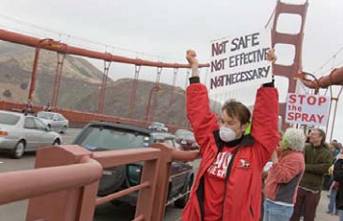 |
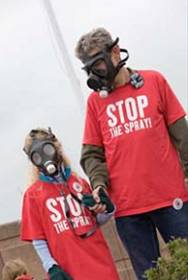 |
| (Photos by Rohan Clarke) |
Sonoma neighborhood targeted with twist ties, June 2008:
LGBT Pride Parade San Francisco, June 2008:
 |
 |
Window display at Modern Times Bookstore in San Francisco, by Anandi, Summer 2008:
Protesting CDFA Secretary Kawamura on panel at Slow Food Nation, San Francisco, August 2008:
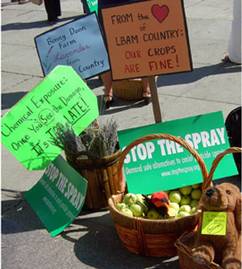
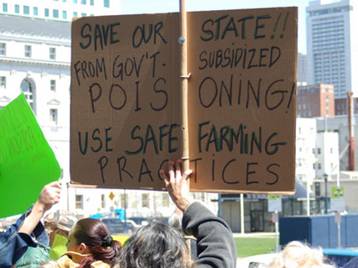
"Chain of Fools", a political satire about the LBAM program by Raphael Mendel, Fairfax, October 2008:

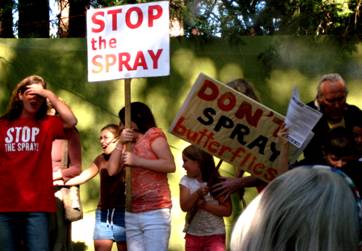
Anniversary Commemoration of the LBAM Aerial Spraying, October 25, 2008:
Berkeley, Environmental Health Network installation of the MCS Memorial Tree:
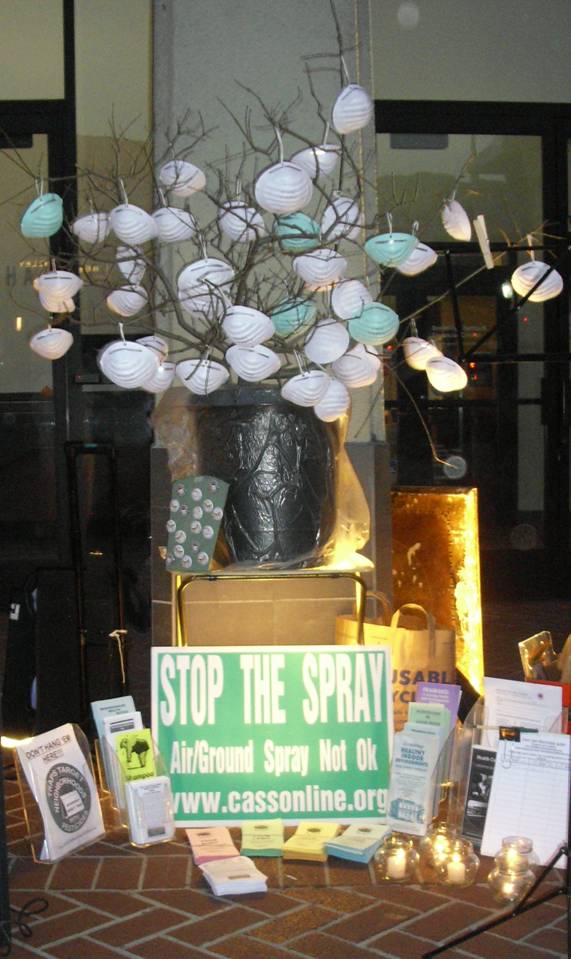
Santa Cruz, 643 candles and candlelight walk:
Protesting releases of irradiated and dyed "sterile" moths, Sonoma Farmers Market, October 20, 2009:
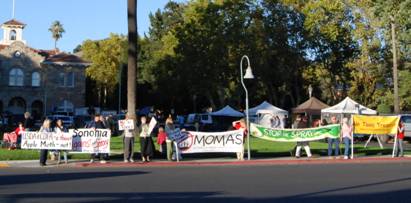
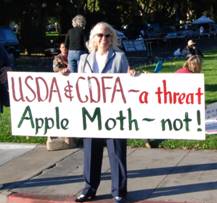
UPCOMING MEETINGS REGARDING LBAM
To organize in San
Leandro email Max Ventura
beneficialbug@netzero.net
PAST EVENTS
Join Us for a
Commemoration Across Regional Boundaries
September 9th marked the first anniversary of repeated spraying of pesticides over Monterey and Santa Cruz. Please take a moment to remember those injured by the LBAM program, and by pesticides in general.
Saturday, October
25, 2008
6-8pm Downtown Berkeley BART Station
For details about simultaneous events elsewhere
see LBAMspray Calendar
NON-VIOLENT
DIRECT ACTION TRAINING
Saturday, July
19,
2008, 10am-5:30pm
1924 Cedar Street (at Bonita), in Berkeley
East Bay Pesticide
Alert & Don't Spray California present
WHO'S AFRAID OF THE LIGHT BROWN APPLE MOTH?
Thursday, June 5 -
7pm
Berkeley Fellowship of Unitarian Universalists Hall, 1924 Cedar Street
(at Bonita Avenue), Berkeley, CA 94709
Co-sponsored by the Social Justice Committee of Berkeley Fellowship of Unitarian
Universalists
Community Brainstorm about the CDFA's LBAM program
with
Dr. Daniel Harder
Executive Director of the UC Santa Cruz Arboretum, Adjunct Professor of
Ecology and Evolutionary Biology Department, Co-Author of the New
Zealand report which contradicts the CDFA's claims that the LBAM is a
threat, and reveals that pesticides are the problem.
David
Theodoropoulos
Biologist and Author of "Invasion Biology: Critique of a Pseudoscience"
which reveals the disturbing connections between invasive species
councils and the pesticide industry.
Caltrans Workers speak out about being injured by pesticides during routine roadside spraying.
Connie Barker
President of the Environmental
Health Network of California, advocating for people with chemical
injuries and sensitivities.
Watch
the Community Brainstorm "Who's Afraid of the Light Brown Apple Moth?
III" in Berkeley (113 minute Google video)
Galvanize Productions
The third video from a DontSprayCalifornia.org event, this was on June 5, 2008 at BFUU in Berkeley, California, and co-sponsored by the Social Justice Committee of the Berkeley Fellowship of Unitarian Universalists. This video goes into the bigger picture of what drives pesticide programs such as the one imposed on California for the Light Brown Apple Moth, and the impact they have on people’s lives. Featured speakers are: David Theodoropoulos, Biologist and Seedsman, debunks “Invasion Biology”, the pseudoscience that drives pesticide programs like the one against the Light Brown Apple Moth, and reveals its racist roots, its warfaring against nature, and its funding by the pesticide industry. Caltrans workers, injured during the extensive routine roadside spraying happening up and down California highways, describe how their lives have been impacted when they were poisoned by pesticides on the job, lied to by Monsanto, and how their doctors letters were ignored, resulting in continuous reinjury through their bosses’ neglect. Connie Barker, President of the Environmental Health Network, puts into perspective how the relationship between the pesticide, pharmaceutical, and medical industry specifically prevents the chemically injured, especially those with Multiple Chemical Sensitivities (MCS), which affects millions across the country, from getting medical care, as was made evident in the aftermath of the spraying over Monterey and Santa Cruz in 2007. Dan Harder, Executive Director of the UC Santa Cruz Arboretum, and co-author of the New Zealand report that revealed that the Light Brown Apple Moth is not a major pest there as claimed, but that pesticides were the cause of previous problems with it there, debunks the CDFA’s LBAM eradication program point by point, as unsafe, unnecessary, and ineffective. Hosted by Maxina Ventura, Founder of Sonoma Pesticide Alert and Don’t Spray California, who outlines the history of some regional struggles since the early 90’s in opposing pesticide use, and clarifies the toxicity of many of the LBAM trapping and eradication methods. There is much misinformation in the media about this issue. DVD available from Galvanize Productions
East Bay Pesticide Alert/Don't Spray California present a Movie Night
Sunday, May 11 -
7pm
Movie Night: "True Accounts of the LBAM Spraying" by Jazz-elle
Berkeley Fellowship of Universal Unitarians Hall, 1924 Cedar Street (at
Bonita Avenue), Berkeley, CA 94709
Co-sponsored by the Social Justice Committee of Berkeley Fellowship of Unitarian
Universalists
BFUU Movie Flyer (pdf)
Wednesday, April
23 - 12-2pm
Berkeley Community College, 2050 Center Street, Berkeley, CA 94704
with Michael Parenti, Maxina Ventura, Nan Wishner, Tara Levy, and others
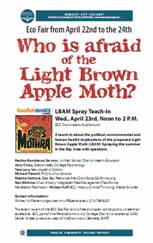
NON-VIOLENT
DIRECT ACTION TRAINING
Saturday, April 19
- 11am-5pm
200 Washington Street #107, Santa Cruz, CA 95060
East Bay Pesticide
Alert & Don't Spray California present
WHO'S AFRAID OF THE LIGHT BROWN APPLE MOTH?
Thursday, April
10, 2008 - 7-9pm
The Ecology Center, 2530 San Pablo Ave, Berkeley, California
Will the light brown apple moth prove to be the invasive threat to California agriculture, that the United States Department of Agriculture (USDA) claims it to be, or have damages to New Zealand agriculture been grossly exaggerated? Should the vulnerabilities created by chemically dependent mono-cropping and other conventional agricultural practices be an excuse for eradication projects that put at risk public and environmental health? What will happen to local organics if the California Department of Food and Agriculture (CDFA) is allowed to douse the California Peninsula and San Francisco Bay Area with pesticides months in and months out for years to come?
Talk with
Miguel Altieri - UC Berkeley Professor of Agroecology and entomologist
Robert Lieber, RN - Mayor of the City of Albany, one of the cities on the list to be sprayed, and Registered Nurse with extensive experience in respiratory care, who provided emergency triage and healthcare after many toxic chemical accidents and releases, including the Chevron spill.
John Davis, RN - Environmental and Peace Activist, works in Pittsburg, Contra Costa County, as a geriatric nurse.
Rob Schultz - Vineyard Manager and Farmer specializing in organics and biodynamics, works with Phil Coturri, who is now helping Napa's Oakville Ranch Vineyards transition to Organic. Rob started farming at the age of 14, and has worked on farms around the world.
Ames Morison - of Medlock Ames Winery, who grow biodynamically and have incorporated sustainable practices such as electric cars run on a solar system, and vineyard equipment powered by biodiesel. They look toward creating their own fuel from crops grown at their ranch.
Berkeley Flyer (pdf)
Watch
the Community Brainstorm "Who's Afraid of the Light Brown Apple Moth?
II" in Berkeley (71 minute Google video)
Galvanize Productions
The second video from a
DontSprayCalifornia.org event, this one April 10, 2008 at the Ecology
Center in Berkeley, California. This goes into the biology, politics
and health issues with California's emergency pesticide spray program
for the Light Brown Apple Moth. Featured speakers are Miguel Altieri,
Professor of Agroecolgy at UC Berkeley; Robert Lieber, RN, Mayor of
Albany, California; John Davis, Geriatric Nurse, Rob Schultz, Vineyard
manger and farmer; Ames Morison, of Medlock Ames Winery. There is much
misinformation in the media about this issue. This video adds important
information and insight.
DVD available from Galvanize
Productions
NON-VIOLENT
DIRECT ACTION TRAINING
Saturday, March 29
- 11am-5pm
200 Washington Street #107, Santa Cruz, CA 95060
East Bay Pesticide
Alert & Don't Spray California present
WHO'S AFRAID OF THE LIGHT BROWN APPLE MOTH?
Sunday, February
24, 2008 - 1:30-3:30pm
Zocalo Coffeehouse, a Family-welcoming Community Spot,
645 Bancroft Ave, San Leandro, California
co-sponsored by the San Leandro Community Action Network
Presentations include:
Background of the program, some pesticide toxicology specifics, and legal update, by the founder of StoptheSpray.org
Speakers include: John Russo, Isabelle Jenniches, Rami Nagel, Maxina Ventura, Steven Munno
A look at the cyclical nature of these kinds of programs, comparing to the Glassy-winged Sharpshooter and Mosquito Abatement programs as well as life lived within one of Sonoma's devastating cancer clusters, by the founder of East Bay Pesticide Alert.org. Tidbits about Caltrans spraying, too
Description by one of the people living in zone directly sprayed who was sickened, as were at least hundreds who reported, to speak about what it was to live through the sprayings, the health problems, being turned away by doctors and turned out by the Public Health Department, and what it is like to live on edge waiting for the next sign of a plane coming to spray, Ag. people coming to tie toxic strips onto the branches of the trees your kids climb, or workers painting utility poles with Permethrin mixed with pheromones
A talk by one of the organic farmers whose farms were sprayed. What are they to do? While CDFA says they still can label organic, this destroys the meaning of the label. So who stands for them, let alone the rest of us who depend on organics for our families' health? How do we come together to support them, and us?
San Leandro Flyer (pdf)
Watch
the Community Brainstorm "Who's Afraid of the Light Brown Apple Moth?"
in San Leandro (90 minute Google video
Galvanize Productions)
A native of
Australia and first discovered in Northern California in 2006, the
Light Brown Apple Moth is the latest insect targeted for "eradication"
by the California Department of Food and Agriculture. Under an
emergency decree, aerial spraying began in Santa Cruz and Monterey
counties in the fall of 2007. Over 600 people reported getting sick
from the synthetic "pheromone" laced pesticide that was used. In Summer
2008 this program will be expanded to the urban counties of the Bay
Area, subjecting some 2,000,000 people to an untested pesticide.
According to Albany, California Mayor
Robert Lieber:
"California Department of Food and Agriculture (CDFA) Secretary
Kawamura's recent emergency declaration enabling the Light Brown Apple
Moth (LBAM) aerial pesticide spraying of the Bay Area relies on blatant
misrepresentations of the truth, fear-mongering and outright lies. The
spray program he defends imperils California's families, children,
pets, and the environment, based on no real science and no solid
facts."
This compelling video from a community meeting in San Leandro,
California goes into the science, the perspective of organic
agriculture and personal experience with pesticide exposure. DVD
available from Galvanize.TV
Some resources to print out and distribute or use in organizing:
Flyer to take to your neighbors, post on bulletin boards, put up in libraries, and table with:
THIS SECTION CURRENTLY BEING UPDATED TO REFLECT CHANGES IN THE LBAM PROGRAM SINCE THE RELEASE OF THE FINAL PROGRAMMATIC IMPACT REPORT. PLEASE CHECK BACK SOON.
Overview Flyers of all pesticides in this program, with pictures
For
posting and distributing in Sonoma as Twist Ties are threatened for
hanging the week of June 16th (pdf)
If you hear that twist-ties are coming to your area, contact EBPA/DSC
and we'll produce a version of the flyer for your area.
Flyer of Non-Toxic, Non-Chemical Alternatives to Managing LBAM if necessary (pdf)
Overview Flyer with Pictures (one sided - for easy posting) (pdf)
Overview Flyer
with
Pictures - 2 sided:
Quarter page
(4-up) (pdf)
Half page
(2-up) (pdf)
Full page
(pdf)
Display pictures with overviews:
Maps (3 pages) (pdf)
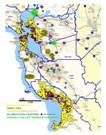
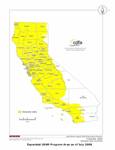
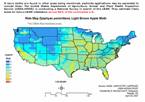
Traps (2 pages) (pdf)
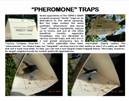
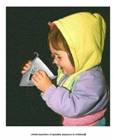
Twist ties (3 pages) (pdf)
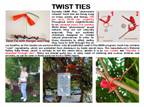

Ground spraying (2 pages,
to tape into 11x17 display) (pdf)
Ground spraying (1
page 8-1/2 x 11) (pdf)
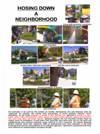
Permethrin mix on
utility poles (2
pages,
to tape into 11x17 display) (pdf)
Permethrin mix on utility poles (1
page 8-1/2 x 11) (pdf)
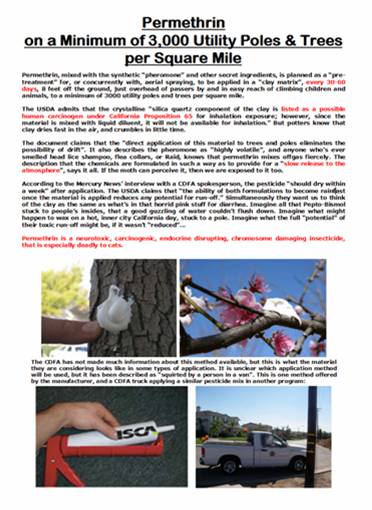
Aerial Spraying (2 pages, to tape
into 11x17 display) (pdf)
Aerial Spraying (1 page
8-1/2 x 11) (pdf)
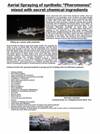
All Displays (14 pages) (pdf)
Posters for windows or signs at protests (8-1/2x11 - can be blown up to 11x17 or larger at copy shops)
Contact:
Contacts for local representatives of areas to be pesticided (as of Spring 2008)
email addresses from above list
of contacts - for easy pasting
(most email programs allow you to send only a limited number at one
time)
Contacts for other government officials and agencies
Contacts for Chambers of Commerce, Agriculture Groups, Service Groups
Official Resolution:
Take this resolution to your municipality, union, schoolboard, organization, homeowners associations, or other entity, and get it passed. Let us know about any resolutions passed so that we can get information up on our site. Please note, as of February 2010, this resolution will need to be updated to reflect the changes in the Final Programmatic Environmental Impact Report. We would be happy to help anyone interested in updating it. Please don't hesitate to contact us at beneficialbug@netzero.net:
Don't Spray
California general resolution (Ms Word)
Don't
Spray California general resolution (pdf)
This resolution was instrumental in helping AFSME Local 2428, workers at the East Bay Regional Park District, craft their own resolution specific to their union's needs
AFSCME Local 2428 Resolution in opposition of the LBAM eradication program (pdf)
The East Bay Regional Park District Board followed suit. While their original resolution proposal was focused on aerial spraying alone, the board agreed with us that all toxic methods must be opposed, and made a last minute change, changing the phrase "chemical compound" to "chemical program".
East Bay Regional Park District (EBRPD) Board Resolution (pdf)
The EBRPD resolution in turn was altered slightly to replace the City of Berkeley's previous resolution opposing only aerial spraying, to better reflect the city's no-pesticide and precautionary principle ordinances:
Berkeley City Council Resolution (pdf) May 6, 2008
The Berkeley Peace and Justice Commission Recommendation to the City Council was also to oppose the entire eradication program, and to take legal action across regional boundaries
Legal Action:
As the Final Programmatic Environmental Impart Report has been released and was certified March 22, 2010, a lawsuit was filed on April 19, 2010, to challenge the continuation and full implementation of the LBAM program:
Please support the statewide lawsuit against the LBAM program of the Stephan C. Volker Environmental Law Firm in Oakland, and Frank Egger, president of North Coast Rivers Alliance (NCRA), and former mayor of Fairfax, which along with Arcata, is one of the only two municipalities in California with a true pesticide ban.
Press Release announcing the Volker lawsuit challenging the EIR
Verified Petition of Writ of Mandate and Complaint for the Volker lawsuit challenging the EIR
Publish:
You can reuse this article for reprinting in local newspapers, newsletters and to send to friends. Simply change the city names and such details to match your locale, and credit to Maxina Ventura or Don't Spray California, www.dontspraycalifornia.org:
Conventional
Agriculture's Problems Come Home to Roost: When the Light Brown Apple
Moth Comes To the Big City (Ms Word)
Conventional
Agriculture's Problems Come Home to Roost: When the Light Brown Apple
Moth Comes To the Big City (pdf)
Music:
For late night organizing around the camp fire, and to liven up the next protest, sing along with this tune:
There
Ain't No Moths On Me, by Charity and the JAMband
"oh there ain't no moths on me - there ain't no moths on me - why you
wanna spray the places we play - when there ain't no moths on me?"
RESOLUTIONS AND OFFICIAL LETTERS
Our proposed resolution was instrumental in helping AFSME Local 2428, workers at the East Bay Regional Park District, craft their own resolution specific to their union's needs.
AFSCME Local 2428 Resolution in opposition of the LBAM eradication program (pdf)
The East Bay Regional Park District Board followed suit. While their original resolution proposal was focused on aerial spraying alone, the board agreed with us that all toxic methods must be opposed, and made a last minute change, changing the phrase "chemical compound" to "chemical program".
East Bay Regional Park District (EBRPD) Board Resolution (pdf)
It also contributed to the recommendation of the Berkeley Peace and Justice Commission:
Berkeley Peace and Justice Commission Recommendation to the Berkeley City Council
The EBRPD resolution in turn was altered slightly to replace the City of Berkeley's previous resolution opposing only aerial spraying, to better reflect the city's no-pesticide and precautionary principle ordinances:
Berkeley City Council Resolution (pdf) May 6, 2008
Other resolutions that oppose the entire program:
Greater Santa Cruz Federation of Teachers AFT Local 2030
Monterey Bay Central Labor Council
Most of the resolutions passed by municipalities oppose aerial spraying, but do not specifically oppose other parts of the pesticide program. Here's a sampling of a resolutions with varying levels of opposition to the program:
The California Coalition of Cities to Stop the Spray (CCCSS) is an informal association of city council members and mayors of cities who have come out publicly against the CDFA's treatment plans for the Light Brown Apple Moth (LBAM).
The cities involved so far, as of May 14, 2008, in order of induction into the Coalition:
Pacific Grove, Monterey, Seaside, Santa Cruz, Santa Cruz County (including Felton, Live Oak, Soquel, Aptos, Amesti, Aptos Hills-Larkin Valley, Day Valley, Corralitos, Freedom, Boulder Creek, Ben Lomond, Interlaken, La Selva Beach, Davenport, Bonny Doon, Brookdale, Lompico, Opal Cliffs, Twin Lakes, Zayante, Rio Del Mar, Pajaro), Albany, Oakland, Berkeley, Fairfax, San Anselmo, Mill Valley, Corte Madera, Emeryville, Sausalito, Richmond, San Rafael, San Francisco City & County, Alameda, Tiburon, Larkspur, Piedmont, Del Rey Oaks, Pacifica, Sonoma, Novato
For more
information contact:
Mike De Lay, Coalition Coordinator mdelay@mbay.net
(831) 238-6252
Tony Madrigal, Santa Cruz City Council Member tmadrigal@ci.santa-cruz.ca.us (831)
295-2518
Albany
(pdf)
The City of Albany's mayor, a registered nurse, vigorously opposes the
toxics program
Berkeley
(pdf) February 26, 2008
The City of Berkeley's original draft resolution, which was replaced by
the much stronger opposition against the entire eradication program
above, on May 6, 2008
Berkeley City Councilmember Dona Spring, admonished Secretary Kawamura: "I would like to suggest, sir, that you don't promote public health by ramming something down the throats of the public. And that's what's happening here, 'cause basically you're saying we're going to do this whether you like it or not. And we're going to do this no matter what the health consequences are. We don't think it's dangerous, but we don't really know for sure."
Berkeley City Council meeting February 26, 2008 (video)
Oakland (pdf)
The city of Oakland's resolution recognizes the effects on all people,
including homeless people, and on all living things.
City of Emeryville (pdf)
Letter from Mayor, Town of Fairfax (pdf)
San Anselmo (pdf)
Pacific Grove (pdf)
City of Monterey (pdf)
City
of Santa Cruz (pdf)
The city of Santa Cruz is suing CDFA and this is their resolution
around the program.
County of Santa Cruz (pdf)
City of Seaside (pdf)
City of Richmond (pdf)
City of Mill Valley (pdf)
City of San Rafael (pdf)
Alameda (pdf)
Corte Madera (pdf)
Sausalito (pdf)
City and County of San Francisco (pdf)
Tiburon (pdf)
Larkspur (pdf)
City of Piedmont (pdf)
Del Rey Oaks (pdf)
Pacifica (pdf)
Sonoma (pdf)
Novato (pdf)
Bay Area Assembly members and Senator introduced legislation regarding LBAM approaches, but NOT ONE bill or resolution actually opposes aerial spraying (nor any other pesticiding) at all, and all merely tweak the conditions already put on such action:
Hancock's AB 2764 The governor should be the only one able to declare an emergency? Our current governor took campaign money from Suterra, the company that manufactures the pesticide that was aerially sprayed in the Fall 2007, and practiced favoritism in a corrupt contract with Porter Novelli, the public relations firm hired to market this poison campaign to the people.
Swanson's AB 2892 A 2/3 majority of registered voters potentially affected should decide? So they get to decide if the other 1/3 of registered and potentially affected voters, non-citizens (legal or otherwise), anyone under 18, and the many disenfranchised for whom access to the polls are difficult (homeless, prisoners, non-english speakers, disabled,...), get poisoned.
Leno's AB 2760 They'll have to do an Environmental Impact Report? Done by contractors who are paid a lot of money by the proponents of pesticide use, to theorize and assess whether there's anything for us to worry about, and if so, how many of our lives are an acceptable risk, before they approve of poisoning us.
Huffman's AB 2765 The bill most likely to actually make some difference, as it calls for disclosure of all ingredients (trade secret or not) to the public. It also calls for notification. So we'll get to know when we're being poisoned, and with what. However, we're still getting poisoned.
Laird's AB 2763 While Assembly Member Laird has been among the first officials to stand up to the CDFA's aerial assaults, this is sadly the most misguided of these bills. What makes it unsupportable is the requirement of a list of "invasives" and "appropriate" approaches, including the use of pesticides in general, which plays right into the hands of the chemical industry, which has been working towards a similar "white list". While Laird's list may seem different, the polar opposite even, because in effect it is a "black list", determining what's not allowed, rather than a "white list" of what is, allowing and disallowing are not mutually exclusive, but overlapping concepts. Allowing one thing may imply disallowing another, and vice versa. A list of "invasives" to eradicate or control implies another list of "non-invasives" to hold supreme. When it comes right down to it, either way, it feeds into the pesticide industry's interests. A list of invasive "threats" is going to pave the way for ever more of these manufactured crises, ever more pesticide assaults by an industry that is not an expert in agriculture at all, but only expert in destroying ecosystems for profit.
Laird's
ACR 117 (pdf)
This is an Assembly Concurrent Resolution, the measure with the most
teeth, as it holds the CDFA accountable for its 2007 actions, and for
determining by independent analysis its responsibility in the reported
health complaints. It states that the burden of proof of health and
environmental safety both for the applications already carried out and
those that are planned, must lie with the state, not the people
affected by its actions.
Migden's
SCR 87 (pdf)
This Senate Concurrent Resolution calls for a moratorium on LBAM aerial
spraying, until the industry can get some "scientists" to declare the
pesticide applications are safe and effective. All the people who got
sick know it's not safe, just like all the many people who've been made
ill by aerial spraying, both over urban and rural areas, both residents
and workers. Why not an end to this and all aerial spraying...?
As the Final Programmatic Environmental Impart Report has been released and was certified March 22, 2010, a lawsuit was filed on April 19, 2010, to challenge the continuation and full implementation of the LBAM program:
Please support the statewide lawsuit against the LBAM program of the Stephan C. Volker Environmental Law Firm in Oakland, and Frank Egger, president of North Coast Rivers Alliance (NCRA), and former mayor of Fairfax, which along with Arcata, is one of the only two municipalities in California with a true pesticide ban.
Press Release announcing the Volker lawsuit challenging the EIR
Verified Petition of Writ of Mandate and Complaint for the Volker lawsuit challenging the EIRHelping
Our Peninsula's Environment (Monterey) Lawsuit (pdf)
HOPE initiated one of the four lawsuits filed so far against the
program.
Williams, et al. v. CDFA, USDA, et al.
Don't Spray California Call to Joint Legal Action against CDFA (pdf)
City
Plans Lawsuit to Stop Moth Spraying March 31, 2008
Berkeley prepares for joint legal action with other Bay Area cities,
but keeps it "regional", instead of uniting with the Peninsula cities
which have been fighting alone since Fall 2007, have already been
sprayed, and will be sprayed again before the Bay Area
In April and May 2008, Santa Cruz and Monterey Counties won a delay in court, until a full Environmental Impact Report (EIR), as required by the California Environmental Quality Act (CEQA), is completed. While we applaud Judge Burdick's and Judge O'Farrell's recognition that the CDFA has not shown the LBAM to warrant an emergency exemption from the CEQA process, it should be noted that neither suits stop ground application, as both original suits were specific to aerial spraying of "pheromones". According to Santa Cruz County Public Information Officer Dinah Phillips, the Santa Cruz decision is about aerial spraying, and toxic ground applications are free to continue. According to David Dilworth, whose organization Helping Our Peninsula Environment (HOPE) filed the Monterey suit, ground applications are not only not covered by the suit, but might be okay'd by HOPE. USDA spokesman Larry Hawkins has since said that "The lawsuits stopped any kind of activity in Monterey and Santa Cruz counties, period," and promises that there will be "no treatment that would occur in the counties until after the EIR is done."
The court rulings are also specific to Santa Cruz and Monterey County only, and other than setting precedent, have no bearing on the CDFA's plans for the San Francisco Bay Area. Immediately after the court ruling in Santa Cruz, however, Governor Arnold Schwarzenegger released a statement to the press that aerial spraying is postponed in all areas targeted for LBAM eradication, until a series of minimal tests, the "6-pack" tests, which test only for acute, not long term effects, are completed on the chemical formulations under consideration for the spraying. The tests are to be conducted by agencies which have already demonstrated their bias in refusing to communicate directly with any of the hundreds of people who were made ill by the spraying last Fall.
When we called the governor's office in San Francisco, we were told by a representative that "the eradication still has to happen" and that "pending aerial treatments with hot spots, the USDA can trump us" and overrule the State's decisions. The woman there also reiterated that the ruling just affects aerial spraying, and that "ground treatments are going to continue at this point". Since then, the CDFA has announced that no additional twist ties will be put up, until the effectiveness of the ones up already can be established.
While it looks like the LBAM program is in a holding pattern at this time, please don't be lured into a false sense of security. Secretary A.G. Kawamura promised that the CDFA will appeal the Santa Cruz court's decision immediately, and United States Department of Agriculture (USDA) Spokesman Larry Hawkins indicated that they will wait to see what happens with the State's appeal, before deciding if Federal officials will step in and continue spraying anyway. This is also confirmed by the USDA-APHIS Frequently Asked Questions recently added on the CDFA site:
"Q: Would USDA
take over the LBAM program if the California Department of Food and
Agriculture (CDFA) is unable to continue?
A: CDFA and USDA are jointly committed to pursuing LBAM eradication in
California given the negative impacts associated with this invasive
alien species to agriculture, the natural environment and horticulture."
And at a meeting with the Sonoma Board of Supervisors, in response to resistance against twist ties in Sonoma, CDFA spokesman John Connell threatened that if enough residents refuse to have them put up in their yards, the CDFA would get a "warrant". CDFA has since demonstrated their determination to bully residents into submission, when they obtained a court order to forcibly spray people's homes in the Ojai Valley, in the Spring of 2009.
In November 2008 the North Coast Rivers Alliance, and a number of plaintiffs representing several of the quarantine areas, launched a lawsuit challenging the EPA's unlawful exemption of CheckMate OLR-F and LBAM-F, and the resulting harm to public health and the environment.ENVIRONMENTAL IMPACT REPORTING
CDFA's
2008 Action Plan
(pdf)
updated April 29 2008
USDA
was not
forced by the courts to produce an Environmental Impact Statement, the
federal equivalent of an EIR, like
CDFA was. Their environmental documentation is limited to Environmental
Assessments:
USDA-APHIS Environmental Assessments - Findings of No Significant Impact
PUBLIC COMMENTS:
Some of the public comments challenging the safety, necessity, and legality of the LBAM program, submitted to the USDA and/or CDFA for their Draft EIR and Environmental Assessments, include the following:
2008 comment period on Draft EIR:
Don't Spray California
Comments on USDA and CDFA Draft EIR Process (pdf)
Chronic Effects Researcher Maxina Ventura
Don't Spray California
Comments on USDA and CDFA Draft EIR process (pdf)
Disabled Access Advocate Isis Feral
Don't Spray
California Additional Comments on USDA PEIR (pdf)
includes both previous EIR comments
Californians for Alternatives to Toxics - EIR Comments (pdf)
LBAM
Treatment Program: A Critical Review of Its Justification, Biological
Impact and Human and Environmental Health Consequences (pdf)
Roy Upton, Lynette Casper, Citizens For Health, and California Alliance
to Stop the Spray
Why
The Low Application Rate of the LBAM Spray Is Not Reassuring
EIR comments by John Thielking
LBAM Draft EIR Comments to CDFA (pdf) Lancelot S. Houston
Public comment was also taken in person at CDFA public comment hearings, some of which can be viewed or heard here:
Santa Cruz Public Comment Hearing Part 1, Part 2, Part 3, Part 4, Part 5, Part 6, Part 7, Part 8, Part 9, Part 10, Part 11
Oakland Public Comment Hearing on KPFA
San Francisco Public Comment Hearing Excerpts
Sacramento Public Comment Hearing Part 1, Part 2
2009 comment period on Draft EIR:
Some of these and other comments are also printed in the Final Programmatic EIR, though a number of them have been misquoted in the transcripts, as well as misrepresented in the responses by the authors of the FPEIR.
Don't
Spray California Comments on Draft Programmatic EIR
(pdf)
Stop the Spray Alameda
County comments (pdf)
Don't
Spray California statement to the California Senate Food and Agriculture Committee
LBAM EIR Hearing chaired by Senator Florez (pdf)
read, and submitted as additional comments to CDFA, by Helen Kozoriz,
Stop the Spray Alameda County (also see video coverage of the hearing: Part 1,
Part 2,
Part 3
or read the transcript
of the hearing)
North Coast Rivers
Alliance (NCRA), et al. Comments by Attorney Stephan Volker
(pdf)
NCRA
accompanying exhibit
(pdf)
Comments by Professor Glen Chase (pdf)
Comments by Roy Upton and Citizens for Health (pdf)
Comments by retired longshoreman, ILWU Local 10, Howard Keylor (pdf)
Comments by Emily Levy (pdf)
Comments by Cheriel Jensen (pdf)
Comments by Kate Bernier (pdf)
Comments by San
Francisco City Attorney Herrera (pdf)
While
we appreciate City Attorney Herrera's useful outline of the many ways
this Draft EIR fails on the legal front, his premise continues to be
that the main problem with this program is aerial spraying, ignoring
the toxicity of the other methods. He also fails to note that
independent experts have shown that the naturalized LBAM is not
expected to become a problem after the many decades it has already been
here.
We would like to see Mr. Herrera and other attorneys take the next logical step and take legal action, demanding that the program be ended, and the money earmarked for it be devoted to subsidizing organic and small-scale, local farmers who have already been negatively impacted by this program, and to compensate the many people who were harmed by this program's pesticide use, including by the twist ties and traps.
Public comment was also taken in person at CDFA public comment hearings, some of which can be viewed in these videos:
Watsonville Draft EIR Hearing Part 1, Part 2, Part 3, Part 4
Oakland Draft EIR Hearing Part 1, Part 2
2009 comments on USDA Environmental Assessment of sterile LBAM releases:
Comments by Entomologist James Carey and Dan Harder of the UC Santa Cruz Arboretum
2010 comments to the California Senate Food and Agriculture Committee LBAM EIR Hearing chaired by Senator Florez on March 23, 2010, the day after CDFA certified the FINAL PEIR:EIR/EIS PROCESS:
How Environmental Impact Reporting works in California and at the federal level:
The California Environmental Quality Act (CEQA) process flow chart
The National Environmental Quality Act (NEPA) process flow chart
Why
bother with Environmental Impact Reports?
The shortcomings of Interpretations of the EIR/CEQA process. According
to the CEQA Deskbook, a standard reference on the subject, an EIR is "a
Bridge between Science and Politics." A better analogy, it seems, would
be a bridge between Politics and Politics.
The true nature of Environmental Assessments (EA), which require the most minimal environmental analysis before a project is approved, quickly resulting in a Finding Of No Significant Impact (FONSI), is illustrated in this humorous spoof of the form to be filled out, when an EA is "undesirable or embarrassing".
"EZ" EA Form
This spoof is courtesy of Medical Anthropologist Sydney Ross Singer, who defends mangroves, coqui frogs, and strawberry guava from "nativist" zealots in Hawaii.
The CDFA claims that the "pheromones" don't hurt anyone, "not even the moth", but the mix of chemicals is in fact legally categorized as a pesticide, meaning intended to kill, whether directly or indirectly. That is after all what "eradication" means. There are laws against claiming pesticides are safe, and as a chemical mix legally categorized as a pesticide, it is illegal to claim that CheckMate is safe. There is also no scientific basis on which the CDFA can make claims as to the safety of this mixture, as it is virtually untested, and until it rained down on Monterey for 5 nights in September 2007, it had never been tested on humans.
The EPA has stated that it "believes use of these pheromone products, including aerial application over residential areas, presents negligible risks to human health and the environment"
And the California Department of Pesticide Regulation Regulation (CDPR) and the Office of Environmental Health Hazard Assessment (OEHHA) are reported to have performed a "review of the CheckMate materials and concluded that they were not likely (pdf) to have caused the reported illnesses."
The CDFA is apparently haunted by unlikely coincidences.
"Negligible risk" is a concept borrowed from "Risk Assessment", which is the industry prefered method of conducting Environmental Impact Reports, a decision-making process of theorizing how much potential risk is acceptable, which basically translates into "how much life is expendable".
The opposite to this line of thinking is the "Precautionary Principle", but acknowledges that scientific uncertainty may also imply potentially serious, irreversible harm to health and the environment. In a nutshell it advocates "better safe than sorry".
These distinctions can make the difference between life and death to the already chemically injured, immune system-compromised, and other vulnerable populations, who are the "acceptable risks" of Risk Assessment, whose personal health is compromised by other people's "feasible" compromises.
When hundreds of people become ill, and countless birds die, as a result of the CDFA dousing our homes with pesticides, their suffering is negligle, and the spraying continues. But the relatively much smaller number of people and birds who get ill from West Nile Virus, is an emergency also demanding spraying.
On March 15, 2010 USDA-APHIS released its draft response to the petitions for LBAM to be reclassified as a "non-actionable pest". In the draft response the agency continues to insist that this harmless insect requires quarantines wherever it is found, but that the goal of the LBAM Program is no longer eradication, but has now shifted into a control program. This new development firmly places the agency's feet on a toxic treadmill that will continue indefinitely, and similar to the gypsy moth programs back East, may in fact become a permanent pesticide program.
USDA-APHIS Draft Response to Petitions dated January 14, 2010
PUBLIC COMMENTS ARE DUE MAY 14, 2010
Comments may be submitted online at
or by mail (send two copies of comments, stating comment refers to Docket No. APHIS-2009-0101) toNotice of Availability of Draft Response in Federal Register dated March 15, 2010
USDA-APHIS previous Draft Response to Petitions dated September 14, 2009
Roy Upton, Citizens For Health, Testimony to California Senate Food and Agriculture Committee March 23, 2010 (pdf)
One
of the co-authors of the Reclassification petition outlines the
critique of USDA's LBAM science by the National Academy of Sciences
point by point, concluding that:
"The
Federal Act that gives USDA its authority to impose programs such as
the LBAM eradication and control program is the Plant Protection Act
(PL 106-224). The Plant Protection Act requires for such programs to be
based on 'sound science'."
In
October
2008 a formal petition
to reclassify the Light Brown Apple Moth was submitted to the USDA.
Reclassification would downgrade the LBAM from a Class A pest,
"requiring" action, to a Class C pest, requiring none, which would
essentially remove the legal reasoning behind LBAM-related quarantines.
The
Reclassification Petition (pdf)
In July 2009 the National Academy of Sciences finally began reviewing
LBAM reclassification, though their project description
appears to imply that what will be reviewed may not be the actual
petition itself, but only the "response" by USDA-APHIS to the petition.
Public Comment is open for the duration of the review, which is
supposed to continue for 3 months.
NAS LBAM Reclassification Review Details
"Review of U.S. Department of Agriculture's Animal and Plant Health
Inspection Service (APHIS) Response to Petitions to Reclassify the
Light-Brown Apple Moth as a Non-Actionable Pest"
"Project Scope
To evaluate the ability of policy and
regulatory decisions to be
supported by sound, scientific evidence and effectively communicated in
a transparent fashion, an NRC committee will examine the scientific
bases of two competing opinions about the classification of the
Light-Brown Apple Moth (LBAM) as an actionable pest, based on petitions
from various parties in California to reclassify the pest, and on
federal documents that justify and defend the rationale for the current
pest classification. The committee will focus on the comprehensiveness
and credibility of the federal justification in light of arguments to
the contrary. The committee will prepare a letter report evaluating
whether the justification:
-- fully considers and addresses the specific arguments for
reclassification raised in the petitions and their accompanying
documentation; and
--clearly articulates a thorough and balanced analysis that
justifies and adequately supports its conclusions in response to the
petition."
Comments regarding the members on the project's provisional committee
were due 20 days after committee membership was announced.
Our comments to the NAS about the committee members and our expectation of the project itself
On September 8, 2009 California Assemblymembers Jared Huffman and Bill Monning, Senators Mark Leno and Joe Simitian, and Petition co-author Roy Upton wrote letters of concern about the limited scope of the project, and expressed their expectation that the NAS review will address reclassification itself.
Letters from Legislators Huffman, Leno, Monning, and Simitian, and Petition co-author Roy Upton
On September 14, 2009, before the end of the expected 3 months duration of the project, the National Research Council of the National Academies released its Letter Report of the review. While it confirms many problems with the justification for classifying LBAM as an actionable pest, the limitation of the project's scope was specifically skewed to review only the USDA's own response to the reclassification petition, and reclassification itself was indeed not addressed. Instead the recommendations appear to be aimed at how USDA-APHIS should represent its actions to the public.
NRC/NAS Letter
Report
Shoddy
Science East Bay Express article in response to the report
"A national panel criticizes the USDA's scientific research on the
light brown apple moth but affirms the agency's power to start another
round of aerial spraying."
Numerous safe, non-chemical alternatives for managing the LBAM exist. Caterpillars are easy to pick by hand or bug vacuum at specific times of the year, and would be welcome work at a living wage for the state's many unemployed.


Natural
enemies of
the LBAM larvae include lacewings
and especially spiders (pdf), and probably many other native
insects. In fact, the list of natural enemies of the LBAM in New
Zealand is vast, with a whole range of different lifeforms, including
many types of wasps, earwigs, and other insects, spiders, a number of
birds, and various parasites. It's likely that there is a similar list
of predators present in our local ecosystems already, which has been
keeping the LBAM in check for years prior to its sudden Columbus-like
discovery in Berkeley. There's unlikely to be a need to release
Trichogramma wasps, native or otherwise, as the CDFA is planning on
doing in several areas in San Francisco and Santa Cruz counties,
totalling 47 square miles according to the CDFA map.
At a rate of one million per square mile one might wonder if such
massive release of 47 million insects might not end up resulting in the
designated pest of their next toxic eradication campaign.
List of natural enemies of the LBAM
In New Zealand, flowering types of buckwheat, phacelia and mustard , sown in grape fields, attract parasitic wasps and other beneficial insects, and buckwheat particularly has been found to extend the food supply of insect predators of the LBAM caterpillar, by days to over a month, also extending their effectiveness in managing the moth.
In permaculture and other ecological design practices, such companion planting is an important strategy for maintaining a healthy, balanced ecosystem. It warrants some serious research into appropriate companion plants, and seeking out the services of members of the local permaculture and agroecology communities. Unfortunately the conventional agriculture industry eliminates ecosystem diversity with their aggressive monocrops, along with potential predators who might develop an appetite for such exotic fare, and in fact cause their fields' vulnerabilities with their ecologically hostile practices in the first place.
The most urgent alternative we propose is a change in attitude towards "pests". The invasive species debate is an intense one among environmentalists. There are strong indications that the invasive species councils are sponsored, even established, by the pesticide industry, as documented by David Theodoropoulos, the author of "Invasion Biology: A Critique of a Pseudoscience".
Natives
vs. Exotics - David Theodoropoulos
Overview of the critique of the invasives movement
Review of "Invasion Biology: A Critique of a Pseudoscience" - Toby Hemenway
Page last updated: 8/7/2015